The Crash at Crush: The Spectacularly Bad Idea That Exploded into History
The late 19th century was an era defined by audacious ideas, unbridled industrialization, and occasionally, spectacularly poor judgment. As the United States barreled through the Gilded Age, the railroad was the undeniable king of American industry. Yet, by 1896, the nation was gripped by an economic depression. The Missouri-Kansas-Texas Railroad—affectionately known as the 'Katy'—was desperate for a way to boost passenger revenue. Enter William George Crush, a charismatic passenger agent with a penchant for the theatrical, who proposed a marketing stunt so profoundly reckless it could only belong to the Victorian era: crashing two massive steam locomotives head-on, at top speed, just for the thrill of it.
Crush's pitch to his superiors was brilliantly simple. The event itself would be entirely free to the public, but the only practical way to reach the middle-of-nowhere crash site was to purchase a $2 round-trip ticket on a Katy train. Railroad executives, blinded by the potential windfall of thousands of ticket sales, greenlit the project without a second thought. They tasked Crush with making the impossible happen, completely underestimating the sheer destructive power of pressurized steam.
The Katy railroad selected a shallow valley just north of Waco, Texas, as the perfect natural amphitheater for the spectacle. Over a few short weeks, an entire temporary town sprang from the Texas dust. Christened 'Crush,' the pop-up city boasted a wooden depot, a telegraph office, saloons, carnival tents, medicine shows, and a massive grandstand for VIPs. On September 15, 1896, an estimated 40,000 people descended upon the valley. For a single, chaotic afternoon, the ephemeral town of Crush became the second-largest city in the entire state of Texas.
To build anticipation, the railroad had toured the two doomed locomotives across the state. Engine No. 999 was painted a brilliant, eye-catching green, while Engine No. 1006 was coated in a vibrant, aggressive red. Both trains pulled cars plastered with advertisements and were operated by seasoned engineers who had volunteered for the dangerous job. As the afternoon sun beat down on the raucous, carnival-like atmosphere, the two iron beasts backed up to opposite ends of a four-mile stretch of custom-built track.
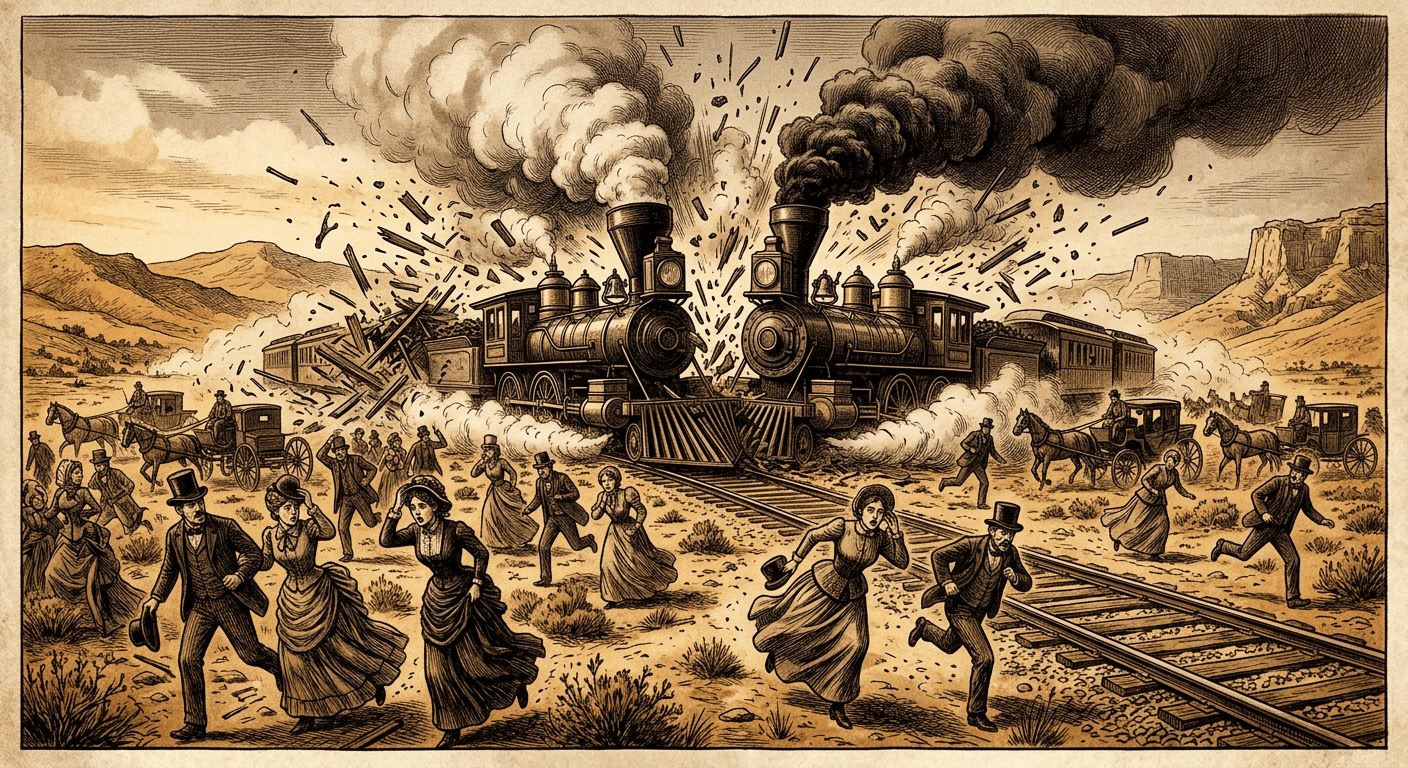
At exactly 5:00 PM, William Crush, riding a magnificent white horse, raised his white Stetson hat and threw it violently to the ground. It was the signal. The engineers tied the train whistles wide open, threw the throttles into full gear, and leaped from the moving cabins. The crowd roared as the two locomotives, belching black smoke and screaming like banshees, hurtled toward each other at roughly 45 miles per hour.
Crush had previously consulted the Katy's top engineers, who confidently assured him that the boilers of the locomotives would not rupture upon impact. They were tragically, catastrophically wrong. The trains collided with a deafening, earth-shaking crunch of twisting metal. For a fraction of a second, the two engines reared up into the air like battling stallions. Then, the immense pressure inside the boilers gave way.
Both boilers detonated simultaneously, creating a tremendous shockwave that swept through the valley. The sky darkened with steam, smoke, and a deadly rain of cast-iron shrapnel. Pieces of metal ranging from the size of a postage stamp to half-ton driving wheels were hurled into the densely packed crowd. The festive atmosphere evaporated instantly, replaced by sheer terror. Men, women, and children scrambled for cover as the sky rained jagged steel.
When the smoke finally cleared, the devastation was horrific. Two young men and a woman had been killed instantly by the flying debris. A photographer who had set up his camera near the impact zone lost his eye to a flying bolt. At least six others were severely mangled, and countless more suffered minor injuries. The grand spectacle had transformed into a bloody disaster zone.
In the immediate aftermath, the Katy railroad quickly fired William Crush, fearing massive public backlash and financial ruin. Yet, the Gilded Age public was a strange beast. Instead of outrage, the nation was captivated by the sheer audacity of the event. Newspapers across the country ran front-page stories, and the Katy railroad received more publicity in a week than it had in its entire existence. Realizing that the phrase 'no such thing as bad publicity' held true, the railroad quietly settled all injury claims and astonishingly rehired William Crush the very next day.
The 'Crash at Crush' passed into the realm of American folklore almost immediately. A young, unknown ragtime composer named Scott Joplin even immortalized the tragedy by writing 'The Great Crush Collision March.' Today, the event stands as a perfectly bizarre time capsule of the 19th century—a moment when the raw, unregulated power of the industrial age was turned into a carnival attraction, leaving an indelible, if explosive, mark on history.