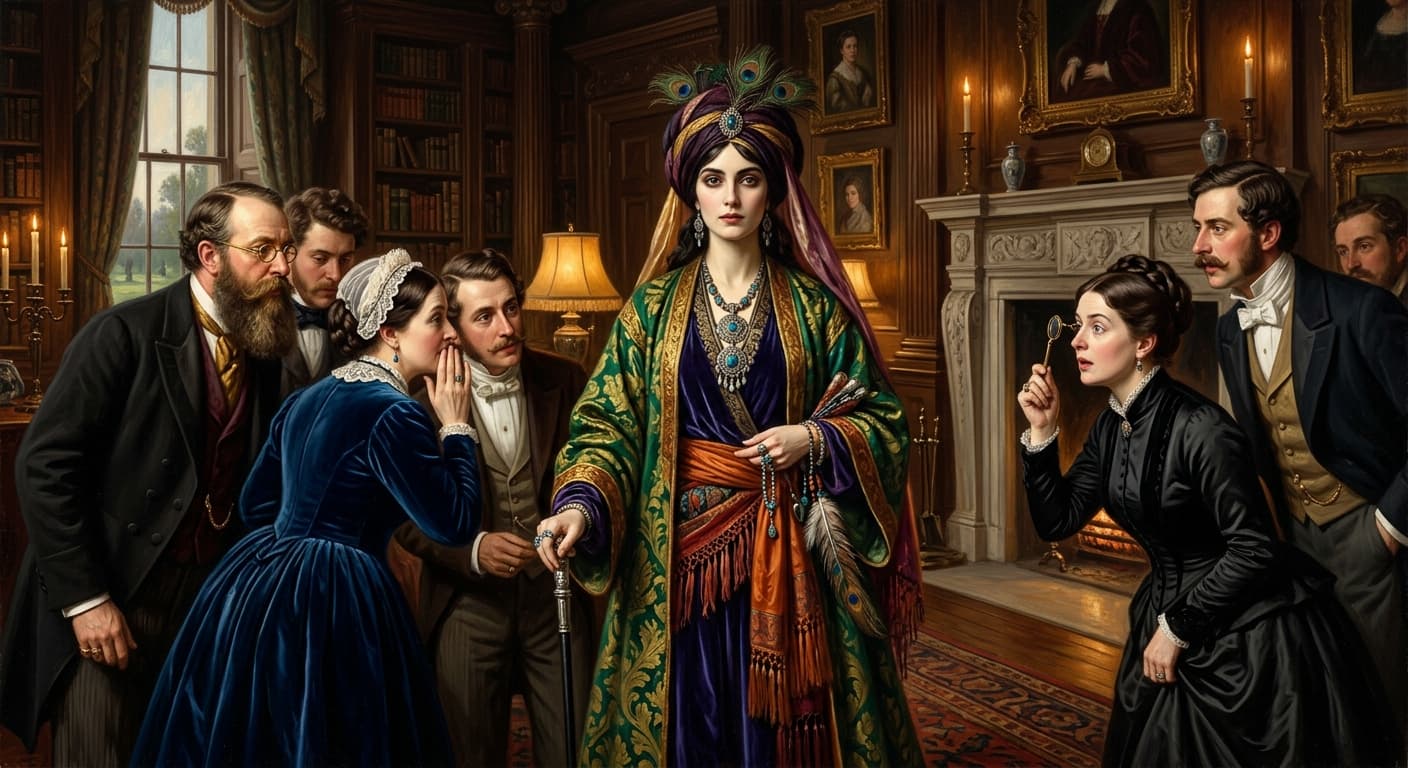
The Cobbler's Daughter Who Conquered High Society: The Absurd Tale of Princess Caraboo
In the spring of 1817, the quiet English town of Almondsbury was thrown into a state of utter bewilderment. A young woman had wandered into the village dressed in a bizarre, improvised gown, wearing a turban on her head, and speaking a melodious but entirely incomprehensible language. When confronted by the local authorities, she communicated only in gestures, refusing all offered food except for tea and vegetables, and insisted on sleeping on the floor.
Thus began one of the most magnificent and embarrassing hoaxes of the 19th century—the reign of Princess Caraboo.
The Enigma of Javasu
Unsure of what to do with the mysterious stranger, the local overseer of the poor brought her to the county magistrate, Samuel Worrall. Worrall’s American-born wife, Elizabeth, was immediately captivated by the young woman. The Worralls took her into their sprawling estate, Knole Park, where she continued to baffle the household.
The mystery deepened until a Portuguese sailor named Manuel Eynesso, passing through the area, claimed he could speak her language. According to Eynesso’s translations, the woman was Princess Caraboo from the island of Javasu in the Indian Ocean. She had allegedly been kidnapped by ruthless pirates, survived a harrowing voyage, and eventually managed to jump overboard in the Bristol Channel, swimming ashore to the English countryside.
High Society’s New Darling
The story was irresistible. In 1817, the British Empire was expanding rapidly, and the upper classes were heavily afflicted with "Orientalism"—a romantic, patronizing obsession with the exotic and the unknown. Princess Caraboo was exactly what the Georgian elite wanted to see.
For the next ten weeks, Caraboo lived as a celebrated royal in Gloucestershire. She charmed the local gentry by fencing, swimming naked in the estate's lake, and praying to her supreme deity, "Allah-Tallah," from the treetops. She fired a bow and arrow with surprising accuracy and crafted intricate clothing from simple fabrics. Local dignitaries flocked to Knole Park to pay their respects. Linguists from Oxford University were dispatched to analyze her complex language, with some confirming it to be a previously undiscovered Eastern dialect.
Her portrait was painted, her story was printed in local and national newspapers, and she became an overnight sensation. The English aristocracy, who considered themselves the most educated and sophisticated people on earth, were eating out of the palm of her hand.
The Unraveling of a Princess
Unfortunately for Caraboo, fame was her undoing. Her striking portrait, published in the Bristol Journal, caught the eye of a boarding house keeper named Mrs. Neale. Mrs. Neale recognized the "Princess of Javasu" immediately—not as royalty, but as Mary Willcocks, a cobbler’s daughter from Witheridge, Devon.
Mary had stayed at Mrs. Neale’s lodging house recently. Far from being an exotic princess, Mary was a brilliant but impoverished English girl who had a lifelong habit of inventing imaginary languages to entertain children. Desperate, broke, and unable to find steady work, Mary had fabricated the Caraboo persona as a last-ditch survival tactic.
When confronted by Mrs. Worrall with this damning evidence, the princess’s exotic accent vanished. In plain, rustic English, Mary broke down and confessed to the entire charade. The "Portuguese sailor" who had supposedly translated for her was likely just another grifter who saw an opportunity to insert himself into the media frenzy, inventing the "Javasu" backstory on the spot, which Mary cleverly played along with.
The Legacy of Caraboo
You might expect the humiliated magistrate Samuel Worrall to throw Mary into a notoriously brutal 19th-century prison for fraud. Astonishingly, he didn't. Perhaps out of genuine affection, or perhaps to quietly sweep the embarrassing affair under the rug, the Worralls actually paid for Mary’s passage to Philadelphia so she could start a new life in America.
Mary's time in the United States was relatively quiet, though she briefly attempted to resurrect her Caraboo persona on stage to little success. She eventually returned to England, married, and settled in Bristol. The former "Princess of Javasu" lived out the rest of her days in obscurity, selling leeches to the local hospital before passing away in 1864.
The tale of Princess Caraboo remains a fascinating footnote in 19th-century history. It stands as a brilliant testament to the power of human ingenuity, the desperate measures of the poor in Georgian England, and the timeless truth that the upper classes will believe absolutely anything—provided it comes wrapped in the right kind of exotic packaging.