Cloudy with a Chance of Mutton: The Bizarre Mystery of the Kentucky Meat Shower
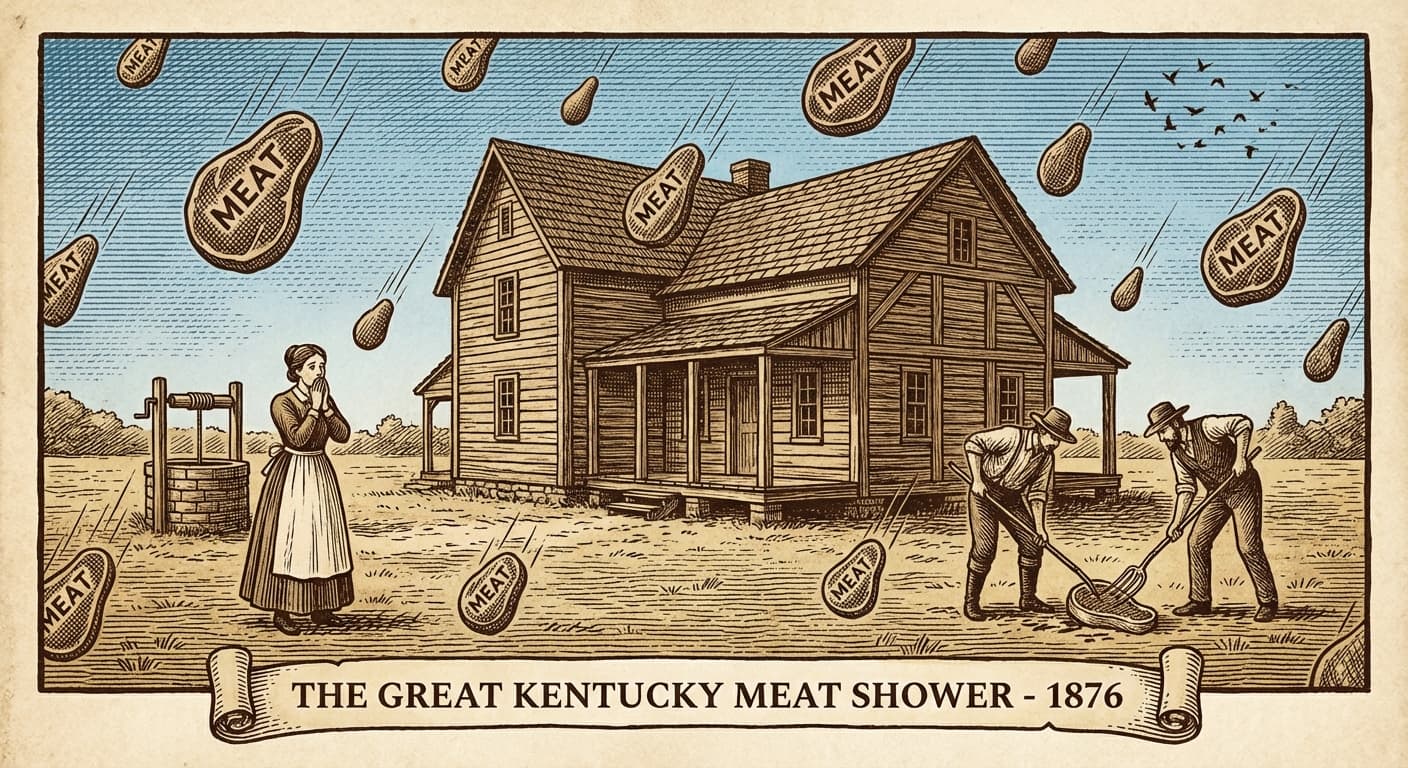
On a crisp, cloudless Friday afternoon in March 1876, Mrs. Allen Crouch was outside making soap in the yard of her farm in Olympia Springs, Bath County, Kentucky. It was the sort of mundane, domestic scene that defined rural 19th-century American life. However, the tranquility was shattered not by a storm or an intruder, but by a phenomenon so grotesque and inexplicable that it remains one of the strangest footnotes in Victorian history. Without warning, the sky began to rain meat.
It wasn't a drizzle, and it wasn't water. For several minutes, chunks of red, fleshy matter fell from a completely clear blue sky, pelting the ground, the fence, and Mrs. Crouch’s soap-making equipment. The chunks ranged in size from small flakes to large strips roughly three inches square. By the time the horrifying precipitation ceased, an area measuring approximately 100 by 50 yards was covered in gore. The event, which would come to be known as the Kentucky Meat Shower, sparked a media frenzy and a scientific debate that highlighted the peculiar intersection of folklore and emerging forensic science in the late 1800s.
The Taste Test
Perhaps the only thing more disturbing than meat falling from the sky was the immediate reaction of the locals. In an era before germ theory had fully permeated the public consciousness, curiosity often overrode caution. Mrs. Crouch described the substance as looking like beef, but the local men decided that observation wasn't enough. In a display of fortitude (or perhaps foolishness) that baffles modern sensibilities, two local men identified as Mr. Gill and Mr. Frisbie decided to taste the sky-meat.
Their culinary verdict was inconclusive but specific. They claimed it tasted neither like beef nor pork, but rather like mutton or venison. The meat was fresh, not rotten, which only deepened the mystery. If it had been a prank, surely the perpetrators wouldn't have used fresh game. If it was a natural phenomenon, where was the animal? And how had it been atomized in the stratosphere?
The Scientific Scramble
News of the event traveled via the telegraph—the Victorian internet—and soon, samples of the Bath County mystery meat were being shipped to chemists and universities across the country. The theories ranged from the plausible to the preposterous.
One initial theory suggested that the meat was actually Nostoc, a type of cyanobacteria that forms gelatinous colonies. Nostoc can appear dried and invisible on the ground, only to swell up into jelly-like blobs when exposed to rain. This "star jelly" was a known phenomenon. However, this theory fell apart quickly. The sky had been clear, there had been no rain, and the samples were fibrous and muscular, not gelatinous. Furthermore, when the samples were preserved in alcohol, they didn't dissolve; they hardened, behaving exactly like animal tissue.
Dr. Allan McLane Hamilton, a prominent physician (and grandson of Alexander Hamilton), examined a sample under a microscope in New York. He identified it unequivocally as lung tissue from a horse or a human infant. Another analyst, Leopold Brandeis, insisted it was Nostoc, seemingly ignoring the fact that it had fallen on a dry day. The scientific community was deadlocked, and the public was enthralled.
The Vulture Verdict
The most enduring and likely explanation came from Dr. L.D. Kastenbine of the Louisville College of Pharmacy. He approached the problem with the deduction of a detective. He noted the specific variety of tissue found in the samples—muscular fibers, connective tissue, and lung matter. He also noted the state of the meat: chopped, torn, and strangely dispersed.
Kastenbine proposed a solution that was as nauseating as it was logical: vulture vomit. Two species of vultures native to Kentucky, the black vulture and the turkey vulture, have a defense mechanism wherein they regurgitate their stomach contents to lighten their load for a quick takeoff if they are startled or pursued. Kastenbine hypothesized that a large flock of vultures, having recently feasted on a dead horse or cow, had been flying at a high altitude over the Crouch farm. Something—perhaps a shift in wind or a startling event—caused the flock to purge their stomachs simultaneously. Gravity took care of the rest.
While this explanation lacked the cosmic allure of a supernatural event, it fit all the physical evidence. The height of the birds explained why Mrs. Crouch couldn't see them; the dispersion of the "rain" matched the scattered flight pattern of a flock; and the "mutton-like" taste reported by the brave taste-testers was simply the result of eating venison or horse that had been partially digested by a scavenger.
A Window into the Victorian Mind
The Kentucky Meat Shower of 1876 is more than just a gross curiosity; it serves as a fascinating lens into the 19th-century mindset. It was a time when the boundaries between superstition and science were porous. It was a world where newspapers would earnestly debate whether meat fell from the heavens or came from the cosmos, and where local farmers would casually eat unidentified biological matter that fell from the sky.
Eventually, the rains washed away the evidence in Bath County, and the news cycle moved on to the next wonder. But for a brief moment, the world looked up at the sky and wondered if the heavens were actually made of meat. The event remains a gruesome reminder that history is not just a list of wars and treaties, but a collection of strange, inexplicable, and occasionally messy moments.