The Cloud That Ate the West: The Apocalyptic Fury of the 1875 Locust Swarm
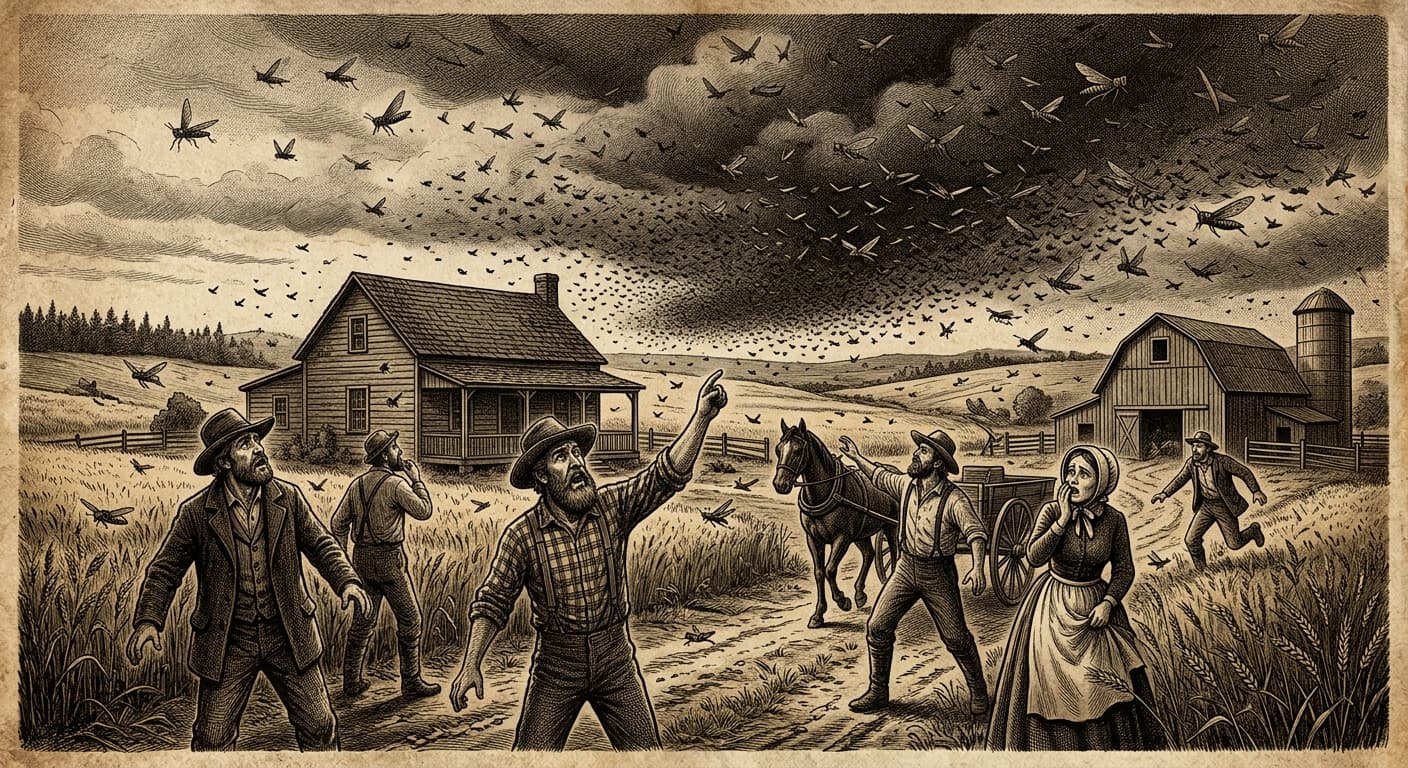
Picture the American West in the summer of 1875. The pioneers and farmers of the Great Plains had endured drought, harsh winters, and financial panics. But on a sweltering July afternoon, a new terror appeared on the horizon. The sky began to darken, not with the bruised purple of an approaching thunderstorm, but with a shimmering, silver-brown haze. The sun was blotted out. A strange, low hum vibrated through the air, growing into a deafening roar that sounded like a rushing waterfall.
It wasn't weather. It was the Rocky Mountain locust, and it was coming for everything.
This wasn't just any swarm. It would later be known as "Albert's Swarm," named after Albert Child, a physician and amateur meteorologist stationed in Nebraska. Fascinated and horrified by the endless river of insects passing overhead, Child used the relatively new telegraph network to contact towns miles away, tracking the swarm's dimensions.
His calculations were so astronomical they defied belief. The cloud of locusts was estimated to be 110 miles wide and 1,800 miles long, covering an astonishing 198,000 square miles. To put that in perspective, the swarm was larger than the entire state of California. Modern scientists estimate that it contained roughly 12.5 trillion insects, weighing a collective 27 million tons. To this day, Albert's Swarm holds the Guinness World Record for the largest concentration of animals ever recorded in human history.
When the swarm finally landed, the devastation was absolute, apocalyptic, and profoundly bizarre. The locusts didn't just eat the wheat and corn. They ate everything.
Contemporary accounts from traumatized pioneers sound like scenes from a horror novel. The locusts consumed the leaves off the trees, the grass down to the roots, and the vegetables in the gardens. When the greenery was gone, their ravenous hunger drove them to the absurd. They ate the wool off the backs of living sheep. They chewed through the leather harnesses of panicked horses. They devoured the laundry hanging on clotheslines, ate the paper off walls, and gnawed on the wooden handles of pitchforks because of the salt left behind by human sweat.
The sheer volume of the insects made daily life impossible. If you stepped outside, you were instantly covered in them. The water in the wells turned brown and toxic from their excrement. The Union Pacific Railroad was brought to a dead halt—not because the locusts blocked the tracks, but because millions of crushed insect bodies turned the rails into a slippery, greasy mess, leaving the massive iron train wheels spinning uselessly in place.
Farmers fought back with everything they had. They set fires, hoping the smoke would drive the insects away. They built "hopperdozers"—horse-drawn scrapers smeared with tar or oil to trap the bugs. They stomped, swatted, and blasted them with shotguns. But how do you fight a trillion of anything? The desperate countermeasures were like trying to hold back the tide with a teaspoon. Families watched their entire livelihood disappear into the jaws of the swarm in a matter of hours.
The devastation plunged the Great Plains into an economic and agricultural crisis. The United States government, along with charities from the East Coast, had to rush emergency rations, seeds, and clothing to the frontiersmen to prevent mass starvation during the following winter.
But the most fascinating part of the 1875 swarm isn't the destruction it caused—it's what happened next.
After bringing the American West to its knees, the Rocky Mountain locust pulled off one of the greatest disappearing acts in the history of biology. Less than thirty years after Albert's Swarm blotted out the sun, the species was extinct. The last confirmed sighting of a living Rocky Mountain locust was in 1902.
How did humanity eradicate a species that numbered in the trillions without modern pesticides? The answer lies in accidental genocide.
The Rocky Mountain locust required highly specific environments to reproduce: the sandy, fertile soils along the river valleys of the West. Unwittingly, the very pioneers who had been terrorized by the bugs held the key to their destruction. As the West was rapidly settled, farmers brought their plows to those exact river valleys. By turning the soil to plant crops, they unwittingly churned up and destroyed the unhatched locust eggs by the billions. They also introduced cows and pigs that trampled the breeding grounds and altered the local ecosystem.
Without ever intending to, the American farmer wiped the Rocky Mountain locust off the face of the earth.
Today, the only remnants of the greatest swarm in natural history are frozen in the ice of the appropriately named Grasshopper Glacier in Montana, where millions of ancient locusts remain perfectly preserved. The terrifying fury of Albert's Swarm remains a bizarre footnote of the 19th century—a stark reminder of both the overwhelming power of nature and the sudden, sweeping impact of human expansion.