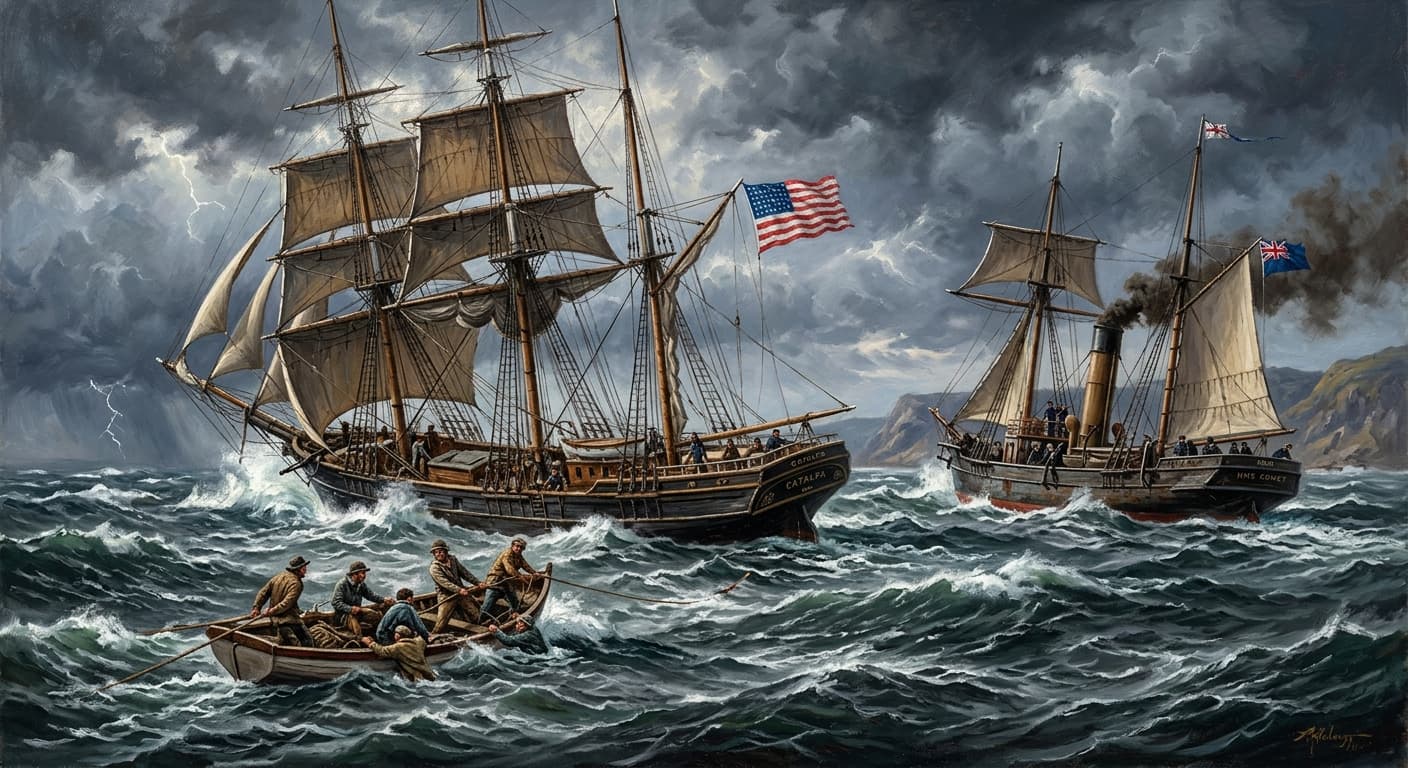
The Catalpa Rescue: The Audacious 19th-Century Heist That Humiliated an Empire
The year was 1876, and the edge of the known world was marked by the imposing limestone walls of Fremantle Prison in Western Australia. To the British Empire, this isolated penal colony was the perfect place to bury their most troublesome subjects. Among the murderers and thieves were members of the Fenian Brotherhood, an Irish republican organization that had dared to stage an armed rebellion against British rule in 1867. While many political prisoners had eventually been pardoned, the British refused to release the military Fenians—soldiers who had mutinied against the Crown. They were condemned to a lifetime of brutal penal servitude, seemingly forgotten by the world. But thousands of miles away, in the bustling taverns and meeting halls of New York City, a brazen plot was being hatched to pull off one of the most audacious prison breaks in history.
The plan was orchestrated by John Devoy, an exiled Fenian leader living in America. After receiving a smuggled, desperate letter from the inmates in Fremantle, Devoy partnered with Clan na Gael, a prominent Irish-American organization. They knew that breaking into a heavily fortified British penal colony required more than just guns and grit; it required unparalleled deception and an entire ship. Using secretly raised funds, the conspirators purchased a three-masted whaling bark called the Catalpa. To make the cover story impenetrable, they hired Captain George Anthony, a seasoned Protestant whaler from New Bedford, Massachusetts. Anthony had no Irish heritage and no stake in the conflict, but he was profoundly moved by the prisoners' plight—and enticed by the sheer thrill of the adventure.
For nearly two years, the Catalpa sailed the world's oceans, legitimately hunting whales to maintain its disguise while slowly making its way toward the Indian Ocean. In the meantime, two Fenian operatives, John Breslin and Thomas Desmond, traveled to Western Australia under assumed identities. Breslin, posing as a wealthy American businessman named 'James Collins', effortlessly infiltrated the colonial high society. He schmoozed with local dignitaries, invested in local businesses, and even managed to secure a personal, guided tour of Fremantle Prison from the governor himself, all while secretly mapping out the facility and passing messages to the incarcerated Fenians.
The meticulous planning culminated on the morning of April 17, 1876. Six Fenian prisoners, who had been assigned to work details outside the prison's main walls, quietly slipped away from their guards. They rendezvoused with Breslin and Desmond, who were waiting with horse-drawn traps. A frantic, galloping race to the coast of Rockingham ensued. Waiting for them in the turbulent surf was Captain Anthony, manning a small whaleboat to row the escapees out to the Catalpa, which was loitering safely in international waters. However, a sudden, fierce squall forced the men to spend a harrowing, miserable night tossing in the open sea, constantly bailing water to keep their tiny craft afloat as British search parties began scouring the coastline.
By dawn, the alarm had fully sounded. The humiliated colonial authorities commandeered the Georgette, a steam-powered gunboat armed with a 12-pounder cannon, and sped out to intercept the fugitives. A desperate oceanic footrace began. The exhausted men in the whaleboat rowed for their lives, just barely managing to hoist themselves over the rails of the Catalpa before the British gunboat bore down on them. The Georgette pulled alongside the whaling bark, its cannon loaded and aimed squarely at the American ship's hull. The British commander demanded the immediate surrender of the six escaped prisoners, firing a warning shot across the Catalpa's bow to prove he wasn't bluffing.
It was in this tense, high-stakes standoff that Captain George Anthony made a legendary geopolitical gamble. Pointing upward to the Stars and Stripes snapping in the wind at the top of the mast, Anthony boldly declared that the Catalpa was an American vessel in international waters. He shouted across the waves that if the British fired upon his ship, it would be considered an unprovoked act of war against the United States of America. The British commander, acutely aware that starting a war with the U.S. over six Irish convicts would be a career-ending—and historically disastrous—move, hesitated. After a tense standoff, the Georgette reluctantly turned back toward the Australian coast.
After surviving the immediate threat, the Catalpa faced an arduous journey home. Months later, the ship sailed triumphantly into New York Harbor to a hero's welcome. Crowds of thousands lined the docks to cheer the liberated men, Captain Anthony, and the brilliant architects of the scheme. The escape severely humiliated the British government, sent shockwaves through the global Irish diaspora, and proved that even the most impenetrable fortress of the 19th century was no match for the audacious combination of a whaling ship, a brilliant disguise, and a healthy dose of international bluffing.