The Giant in the Earth: How the Cardiff Giant Hoax Fooled America
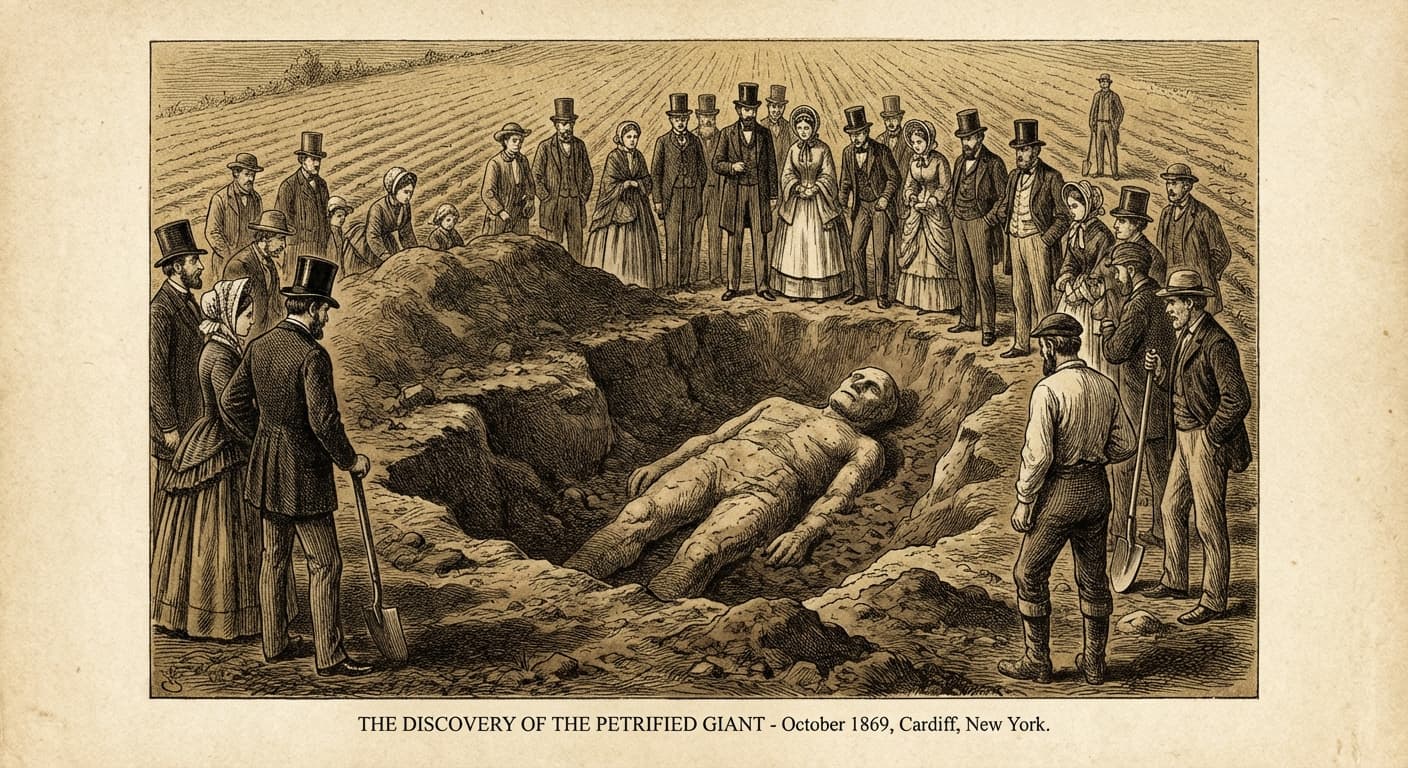
On a crisp October morning in 1869, two laborers were digging a well on William "Stub" Newell's farm in Cardiff, New York, when their shovels struck rock. It wasn't a boulder or a slab of limestone. As they cleared away the dirt, a massive stone foot emerged, followed by a leg, a torso, and finally, the benevolent, peaceful face of a man. But this was no ordinary man. He was ten feet tall, weighed nearly 3,000 pounds, and appeared to be a perfectly preserved, petrified giant from an ancient age.
A Biblical Sensation
News of the discovery spread through the Finger Lakes region like wildfire. Within days, neighbors, reporters, and scientists were flocking to Newell’s farm to gaze into the pit. The timing was perfect. The United States was in the midst of a religious revival, and debates raged between scientific Darwinism and Biblical literalism. For many, the "Cardiff Giant" was undeniable proof of Genesis 6:4: "There were giants in the earth in those days."
Local clergy fell to their knees in awe. Speculators argued over whether it was an ancient statue or a fossilized man (a "petrified giant"). The consensus among the hopeful leaned toward the latter. Even the state geologist of New York initially hesitated to call it a fake, noting the intricate details of the figure, including what appeared to be skin pores. Stub Newell set up a tent over the pit and began charging fifty cents for admission. It was an immediate goldmine, drawing thousands of visitors who waited for hours to see the "American Goliath."
The Atheist's Revenge
However, the giant was not a miracle of history; it was a masterpiece of spite. The mastermind behind the hoax was George Hull, a cigar manufacturer and staunch atheist from Binghamton. Two years prior, Hull had engaged in a heated theological debate with a Methodist minister in Iowa who insisted that the Bible be taken literally—including the references to giants. Hull, incensed by the minister's stubbornness, decided to manufacture a giant to prove just how gullible the faithful could be.
Hull's execution was meticulous. He purchased a five-ton block of gypsum in Fort Dodge, Iowa, claiming it was for a Lincoln monument. He shipped it to Chicago, where he hired stonecutters to carve the figure, swearing them to secrecy. Hull posed as the model himself. To simulate great age, he hammered the stone with knitting needles to create "pores" and treated the surface with sulfuric acid to give it a weathered, ancient patina. He then shipped the giant by rail and wagon to his cousin Stub Newell’s farm, where they buried it in the dead of night, leaving it to "cure" in the earth for a year before staging the discovery.
Enter P.T. Barnum
As the fame of the Cardiff Giant grew, it caught the eye of the Prince of Humbugs himself, P.T. Barnum. Realizing the money to be made, Barnum offered to buy the giant for $50,000. When the syndicate that had bought the giant from Newell refused, Barnum simply hired a sculptor to create a plaster replica. He put his duplicate on display in New York City, brazenly claiming that his was the original and the one in Cardiff was the fake.
In a hilarious twist of irony, Barnum’s fake drew larger crowds than the original fake. The owners of the Cardiff Giant sought an injunction to stop Barnum, but the judge reportedly denied it, quipping that he couldn't grant an injunction against a fake of a fake.
The Unraveling
The hoax eventually collapsed under scientific scrutiny. Othniel Charles Marsh, a renowned paleontologist from Yale (and future combatant in the "Bone Wars"), took one look at the giant and declared it "of very recent origin, a most decided humbug." He noted that gypsum dissolves in water and would not have survived centuries in the wet earth of New York. Furthermore, rumors began to trickle out from residents who remembered seeing a massive wagon hauling a heavy load toward the Newell farm the previous year.
George Hull eventually confessed to the press in December 1869, delighted that he had successfully fooled the experts and the clergy. Rather than being angry, the American public was amused. They admired the sheer audacity and craftsmanship of the con. The Cardiff Giant became a symbol of the 19th-century American love for spectacle and "humbuggery."
Today, the giant rests at the Farmers' Museum in Cooperstown, New York—a ten-foot tall monument to skepticism, gullibility, and the lengths one man would go to win an argument.