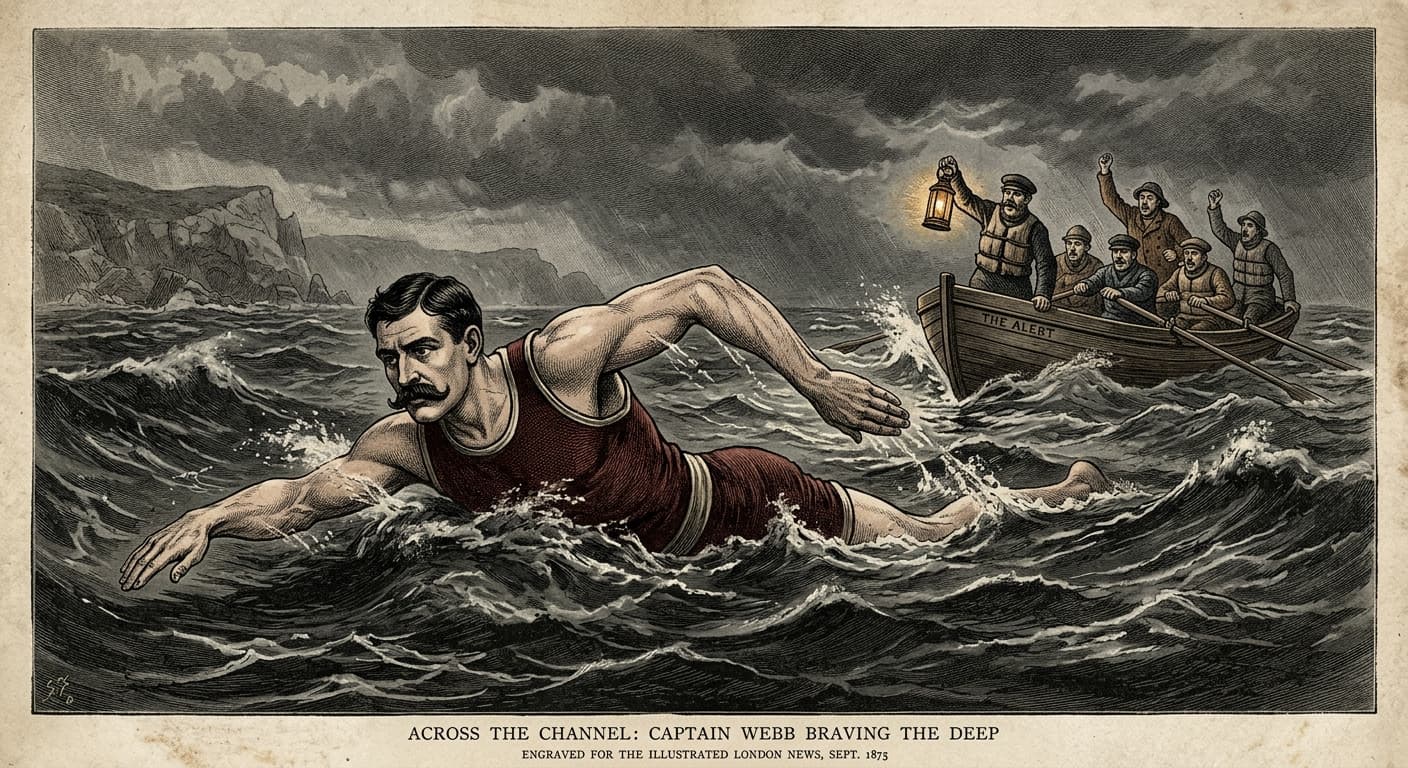
Porpoise Oil, Brandy, and the Breaststroke: How Captain Matthew Webb Conquered the English Channel
In the pantheon of 19th-century trailblazers, we often celebrate the inventors who tamed electricity and the engineers who laid rails across continents. But in the summer of 1875, a different kind of pioneer stepped onto a pier in Dover, England. He didn’t have a machine, a patent, or an army. He had a pair of red silk trunks, a magnificent Victorian mustache, and an absurd amount of porpoise oil.
His name was Captain Matthew Webb, and he was about to do something the medical and scientific communities of the era declared physically impossible: swim across the treacherous, freezing expanse of the English Channel.
Born in Shropshire in 1848, Webb was a natural waterman. He joined the merchant navy as a teenager and quickly built a reputation for immense physical strength and a reckless disregard for his own safety. He first made national headlines in 1873 when he dove off the deck of a transatlantic steamer into the churning, storm-tossed Atlantic in a desperate—though ultimately unsuccessful—attempt to save a man who had fallen overboard. The heroic failure earned him the Stanhope Gold Medal and a taste of public adoration, but Webb was hungry for a more permanent place in the history books.
At the time, the English Channel was seen as a barrier only ships could conquer. The freezing temperatures, volatile tides, and sheer distance (21 miles at its narrowest point) made it a death trap for any swimmer. But when Webb heard that another man had attempted the feat and failed, he abruptly quit his career as a sea captain, determined to be the first to conquer the strait.
Webb’s training regimen was as spectacularly Victorian as you might imagine. He swam for miles in the Thames and the sea, enduring the freezing British waters to acclimatize his body. Crucially, Webb did not use the modern freestyle crawl, which was then considered an "un-British" and excessively splashy technique. Instead, he relied on the slow, steady, and energy-conserving breaststroke.
On the afternoon of August 24, 1875, Webb stood on the Admiralty Pier in Dover. To protect against the lethal chill of the water, his crew slathered him from head to toe in a thick, foul-smelling layer of porpoise oil. At 12:56 PM, he dove into the dark waters, accompanied by three small escort boats carrying referees, journalists, and a vital crew of supporters.
The crossing was a brutal war of attrition. The Channel’s notorious tides treated Webb like a piece of driftwood, pulling him miles off his direct course. While the straight-line distance to France was 21 miles, the zig-zagging currents meant Webb actually swam nearly 39 miles. As day turned into a pitch-black night, the water grew rougher.
To keep his engine running, Webb didn't rely on modern sports gels or electrolytes. Instead, his crew leaned over the sides of the escort boats to pass him a thoroughly 19th-century athletic diet: hot coffee, beef extract, strong English ale, and when he was badly stung by a jellyfish, generous swigs of brandy to dull the pain.
By the early hours of the next morning, Webb was exhausted, hallucinating, and fighting against a tide that seemed determined to keep him away from the French shore. But his relentless breaststroke never faltered. Finally, at 10:41 AM on August 25, after 21 hours and 45 minutes of continuous swimming, Webb’s feet touched the sands of Calais. He dragged his battered, oil-slicked body out of the surf, becoming an instant global legend.
Webb’s return to England was met with the kind of fanfare reserved for conquering generals. He was mobbed by crowds, his face was plastered on matchboxes and commemorative pottery, and he earned a fortune on the lecture circuit. He proved that the human body was capable of enduring extremes that science had previously written off.
Tragically, like many Victorian daredevils, Webb became a victim of his own mythos. Desperate to maintain his fame and fortune, he continually sought out deadlier challenges. In 1883, he traveled to North America to attempt an impossibly dangerous swim through the Whirlpool Rapids below Niagara Falls. It was a fatal miscalculation; the crushing currents pulled him under, and the great conqueror of the Channel was lost to the river.
Despite his tragic end, Captain Matthew Webb’s 1875 triumph remains a watershed moment in human endurance. He didn't just cross a body of water; he crossed a psychological threshold, proving to a rapidly industrializing world that the raw, unassisted human spirit could still conquer nature's most formidable barriers.