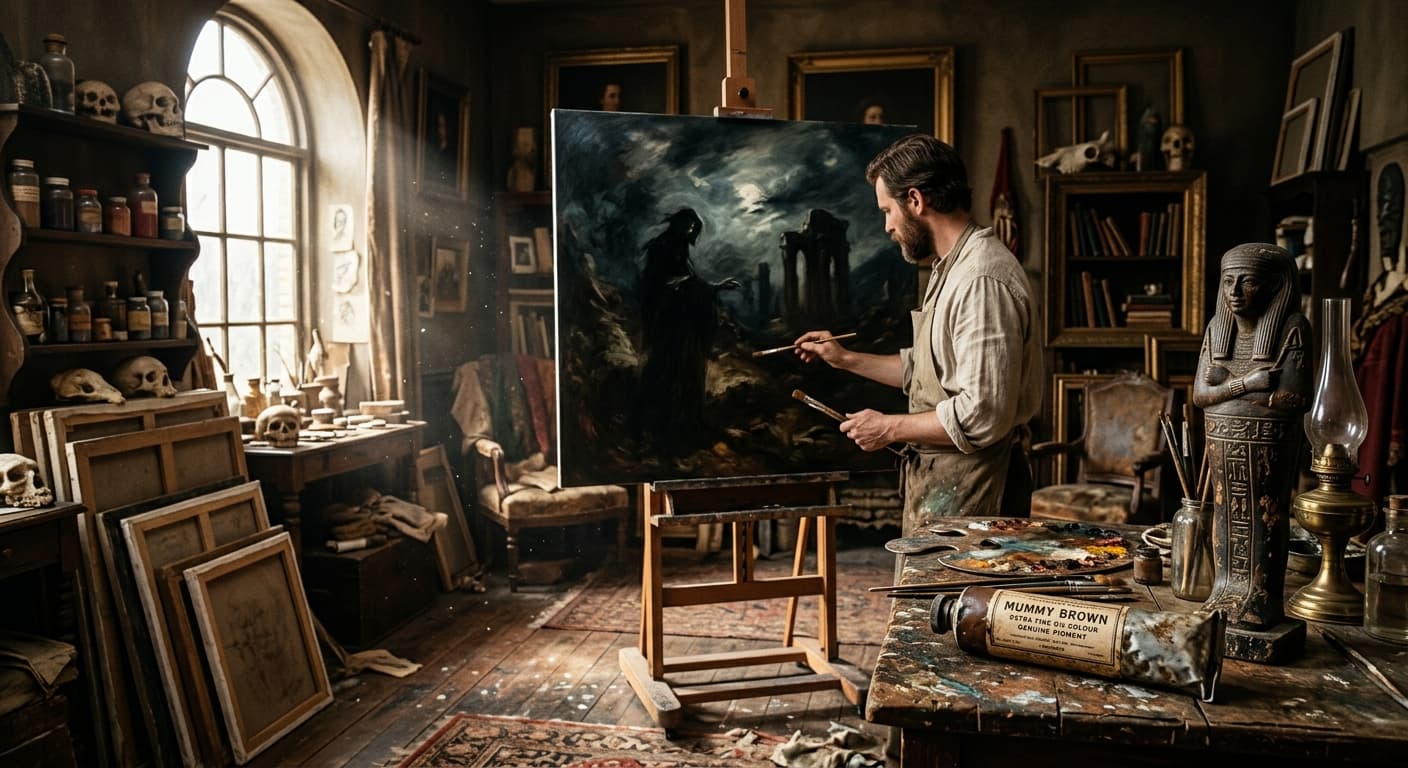
The Canvas and the Crypt: The Bizarre Victorian Obsession with Mummy Brown Paint
The 19th century was an era defined by a peculiar blend of grand industrial progress and delightfully morbid fascinations. Following Napoleon Bonaparte's campaign in Egypt at the dawn of the century, the European continent was swept up in a cultural wave known as 'Egyptomania.' From architecture and literature to fashion and parlor games, the Victorian public could not get enough of the ancient pharaohs. But while most people contented themselves with reading translated hieroglyphs or attending mummy-unwrapping parties, the European art world took this obsession to an entirely different—and profoundly literal—level.
Painters in the 19th century did not have the luxury of the safe, purely synthetic colors that artists enjoy today. Their palettes were a veritable menagerie of the dangerous, the toxic, and the bizarre. There was Emerald Green, which was laced with deadly arsenic, and Lead White, which slowly poisoned the artists who breathed it in. But perhaps the most shocking resident of the Victorian paint box was a rich, warm, and highly prized pigment that offered unparalleled depth for shadows and flesh tones.
Enter 'Mummy Brown.' Also known by its Latin moniker 'Caput Mortuum' (literally 'dead head'), this pigment was not merely a clever marketing gimmick to capitalize on the Egyptian craze. It was exactly what it sounded like: the pulverized remains of ancient Egyptian mummies, mixed with white pitch and myrrh. When mixed with oil, the ground-up ancients produced a beautiful, transparent amber hue that flowed exquisitely across the canvas, allowing artists to create stunning glazes and lifelike midtones.
The supply chain for this artistic marvel was undeniably grotesque, yet entirely normalized during the 1800s. The trade in ancient Egyptian bodies was a booming, unregulated industry. Mummies were exported to Europe by the literal ton. While the most pristine specimens found their way into the glass cases of the British Museum or the private collections of wealthy aristocrats, the less photogenic remains—those damaged by tomb robbers or simply considered 'surplus'—were sold off for scrap. They were utilized as agricultural fertilizer, occasionally burned as locomotive fuel, and, most famously, ground up by apothecaries and color merchants to be sold in neat little tubes to painters.
Mummy Brown achieved its highest critical acclaim among the Pre-Raphaelite Brotherhood, a group of rebellious mid-19th-century English painters who sought to return to the abundant detail, intense colors, and complex compositions of 15th-century Italian art. Renowned artists like Lawrence Alma-Tadema and Edward Burne-Jones were known to be ardent fans of the pigment. For a time, it seemed that no self-respecting Victorian artist could capture the perfect shadow without dipping their brush into the dust of a pharaoh, a high priest, or an unfortunate commoner who had been resting in peace for three millennia.
The turning point for this macabre medium is best captured in a legendary anecdote from the late 19th century. The story goes that Lawrence Alma-Tadema and Edward Burne-Jones were socializing when the topic of their beloved Mummy Brown arose. Alma-Tadema casually mentioned the actual, literal ingredients of the paint. Burne-Jones was reportedly stunned. Like many artists of the time, he had simply assumed 'Mummy Brown' was a fanciful trade name, much like 'Dragon’s Blood' (which was made from tree resin). Horrified that he had been painting with the desecrated remains of real human beings, Burne-Jones allegedly rushed to his studio, retrieved his tube of Mummy Brown, and gave it a solemn, respectful burial in his backyard garden.
This sudden realization of what they were actually smearing on their canvases sparked a slow but steady decline in the pigment's use. As the 19th century waned and the 20th century dawned, a growing sense of scientific ethics and historical preservation began to take hold. Furthermore, the supply of high-quality mummies began to dry up. The booming trade had exhausted the easily accessible tombs, and the Egyptian government began strictly regulating the export of their ancestors.
By the time the modern era arrived, Mummy Brown had largely vanished from artists' palettes, replaced by synthetic alternatives that mimicked its warm glow without the ethical baggage. The most famous eulogy for the color came in 1964, when the managing director of a London-based color maker told Time magazine that they could no longer manufacture the paint because they had simply 'run out of mummies.' Today, art historians and conservators face a delightfully eerie reality: hanging on the walls of the world's most prestigious museums are masterpieces of 19th-century art that double as the final, unorthodox resting places of ancient Egyptians.