The Fatal Dash: How Hubris and a Chinese Gong Doomed the Burke and Wills Expedition
In the mid-19th century, the map of Australia was a tantalizing mystery to European colonists. While the coastal fringes boasted booming cities fueled by the gold rush, the vast, arid interior was a blank canvas labeled simply "The Ghastly Blank." In 1860, the government of South Australia offered a staggering reward of £2,000 to the first expedition to cross the continent from south to north. Not to be outdone, the wealthy citizens of the rival colony Victoria organized an expedition of their own. It was to be the most lavishly funded, heavily equipped exploratory mission in Australian history. Yet, it would end as one of the Victorian era's most devastating monuments to arrogance and unpreparedness.
To lead the Victorian Exploring Expedition, the committee inexplicably bypassed seasoned bushmen and instead appointed Robert O'Hara Burke. Burke was a dashing, hot-headed Irish police officer with a magnificent beard, a flair for the dramatic, and absolutely no exploration experience. His second-in-command, William John Wills, was a brilliant but dangerously submissive meteorologist and surveyor. Together, they were placed in charge of a colossal caravan of men, horses, and wagons, as well as 26 camels specially imported from India to traverse the unforgiving desert.
If Burke lacked bushcraft, he certainly made up for it in baggage. The expedition’s packing list was a masterpiece of Victorian absurdity. Instead of prioritizing survival gear, Burke's caravan lugged 20 tons of equipment out of Melbourne. This included a heavy cedar camp desk, massive quantities of hair oil, 1,500 pounds of sugar, and an elaborate Chinese gong, presumably to call the exhausted men to dinner in the middle of the desolate outback. They brought enough provisions to last two years, but almost completely ignored the survival techniques of the Indigenous Aboriginal people who had thrived in the landscape for millennia.
The expedition departed Melbourne in August 1860 to the cheers of 15,000 spectators, but the sheer weight of their ridiculous cargo immediately bogged them down. Frustrated by the glacial pace, Burke made the first of several fatal decisions. He split the party, leaving the bulk of the men and supplies at a base camp, and raced ahead to Cooper Creek with a smaller team. By the time they reached the creek, summer had arrived, bringing blistering temperatures that soared above 120 degrees Fahrenheit. Impatient and terrified that a rival expedition might beat him to the northern coast, Burke split his party again. He took Wills and two other men, John King and Charles Gray, and made a mad, 1,500-mile dash for the Gulf of Carpentaria.
Against all odds, the four men reached the mangrove swamps of the northern coast in February 1861. They had crossed the continent, but the victory was hollow. The terrain was so waterlogged they couldn't even see the ocean, and their supplies were critically low. The return journey was a grueling nightmare of starvation, torrential monsoons, and dysentery. Gray died of exhaustion along the way. The remaining three men—emaciated, hallucinating, and barely able to walk—finally stumbled back into the Cooper Creek depot on April 21, 1861.
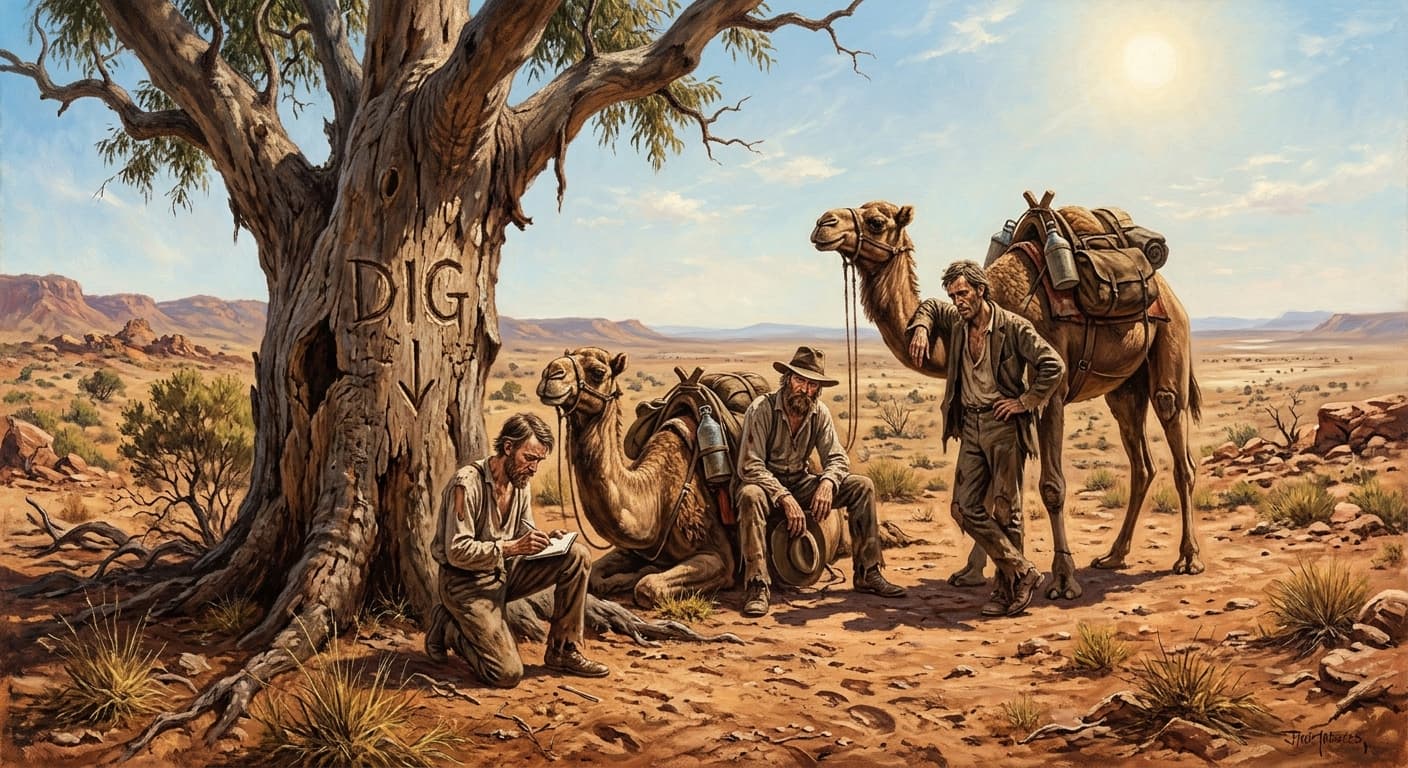
What they found there is one of the most heartbreaking moments in the history of exploration. The camp was completely abandoned. On the trunk of a large coolibah tree, someone had freshly carved the word "DIG." Upon excavating the soil beneath, Burke found a meager cache of supplies and a letter from the depot's commander, William Brahe. The letter explained that after waiting four grueling months, the depot team had finally given up hope and departed for Melbourne. Looking at the date on the letter, Burke and Wills realized the devastating truth: Brahe's team had left a mere nine hours before they arrived.
Exhausted and broken, Wills and King wanted to follow Brahe's tracks, but the stubborn Burke overruled them. He insisted they strike out for a different outpost at Mount Hopeless—a darkly ironic name that would seal their fate. Their strength quickly failed, and they became stranded in the desert. The local Yandruwandha people took pity on the dying explorers, offering them fish and a type of flour made from nardoo fern spores. However, Burke—ever the prideful Victorian—drove their saviors away with a pistol. Worse yet, when the men tried to prepare the nardoo themselves, they failed to roast it properly, leaving an enzyme that prevented the absorption of Vitamin B1. They were essentially starving to death on full stomachs.
By the end of June 1861, both Burke and Wills succumbed to starvation and exposure in the merciless outback. Only John King survived, entirely because he humbled himself, sought out the Yandruwandha, and lived among them until a rescue party found him months later. Today, the tragic saga of Burke and Wills is a legendary Australian epic. It stands as a profound reminder that all the funding, technology, and Chinese gongs in the British Empire were no match for the unforgiving reality of nature, and that the deadliest baggage a Victorian explorer could carry was his own hubris.