The Anatomy Murders: How Burke and Hare Turned Grave-Robbing into a Deadly Enterprise
Edinburgh in the 1820s was the undisputed medical capital of the world. Aspiring surgeons flocked to the Scottish city in droves to learn from the brightest minds of the era. But this golden age of medicine had a dark, festering underbelly. To master anatomy, medical students desperately needed human bodies to dissect. According to British law at the time, only the corpses of executed criminals could be legally used for medical research. As the number of ambitious medical students surged, the number of executions plummeted, creating a severe and sudden shortage of anatomical subjects. The basic laws of supply and demand kicked in, giving rise to a macabre new industry: the "Resurrection Men."
These body snatchers prowled the local graveyards under the cover of darkness, unearthing freshly buried corpses to sell to desperate anatomy professors. The public was understandably terrified. Grieving families began employing armed guards, building heavy iron cages called "mortsafes" over gravesites, and erecting tall stone watchtowers in cemeteries to protect their deceased loved ones. Digging up bodies became increasingly difficult, dangerous, and physically exhausting. Enter William Burke and William Hare, two Irish laborers living in Edinburgh who discovered a gruesome shortcut. They didn't bother digging up the dead. They decided to make them.
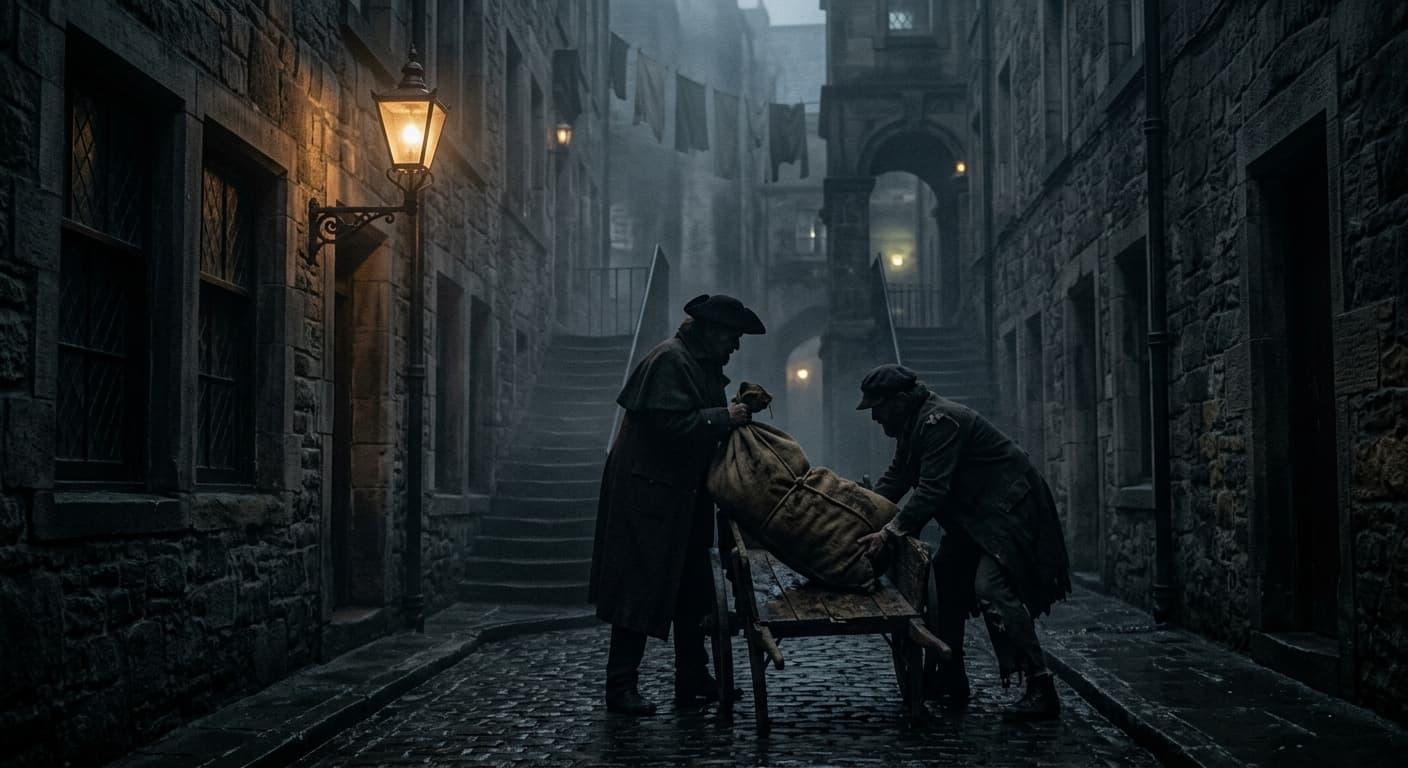
The terrifying saga began almost by accident in late 1827. Hare ran a squalid, bustling lodging house in Tanner's Close, where an elderly pensioner named Old Donald died of natural causes, owing Hare four pounds in unpaid rent. To recoup the debt, Hare, alongside his friend Burke, filled Donald's wooden coffin with tanning bark to fool the undertaker and hauled the actual body to the esteemed anatomy school at Surgeon's Square. They were directed to Dr. Robert Knox, a brilliant and flamboyant anatomist who asked no questions and happily paid them seven pounds and ten shillings—a small fortune for two impoverished laborers.
Realizing just how lucrative a fresh corpse could be, the duo quickly grew impatient waiting for lodgers to die naturally. Their first deliberate murder victim was an ailing tenant named Joseph the Miller, whom they suffocated in his bed. Over the next ten months, Burke and Hare engaged in a ruthless, calculated killing spree, claiming the lives of at least sixteen people. They targeted the vulnerable, the destitute, and the marginalized—individuals whose sudden disappearances were unlikely to cause a stir among the authorities. Prostitutes, street entertainers, and impoverished travelers were lured into the lodging house, plied with heavy amounts of whiskey until they passed out, and then murdered.
Their method of killing was brutally efficient and forensically undetectable at the time. One man would hold the victim's arms and chest, applying heavy pressure to restrict breathing, while the other clamped a strong hand over the nose and mouth. This suffocating technique left no marks, bruises, or signs of struggle on the corpse, ensuring the bodies appeared entirely unblemished and pristine for the dissection table. The method became so notoriously effective that it permanently entered the English lexicon as "burking," a term used to describe killing someone by suffocation.
Dr. Robert Knox proved to be an insatiable customer. Although Knox never directly asked where the alarmingly fresh bodies were coming from, historians widely agree he deliberately chose to turn a blind eye. The sheer freshness of the victims, some of whom still had warm flesh and blood that hadn't fully coagulated, should have been a glaring red flag to any seasoned medical professional. Yet, the booming financial success of his crowded anatomy lectures blinded him to the grim reality of his supply chain.
The murderous enterprise finally unraveled on Halloween night in 1828. Burke and Hare targeted a middle-aged Irish woman named Margaret Docherty. After murdering her, they carelessly hid her body under a pile of straw beneath a bed in Burke's room, planning to transport her to Dr. Knox the following evening. However, two other lodgers, Ann and James Gray, grew highly suspicious when Burke aggressively refused to let them approach the bed to retrieve a pair of stockings. Once left alone in the room, the Grays discovered Docherty's lifeless body and immediately fled into the night to alert the police.
The ensuing investigation sent absolute shockwaves through Edinburgh and the broader global medical community. Faced with the gallows, Hare was offered immunity from prosecution if he turned King's Evidence against his partner in crime. He eagerly accepted the deal, condemning his friend to death. William Burke was hanged on January 28, 1829, before a massive, roaring crowd of 25,000 spectators who chanted for his blood. In a fitting, poetic twist of irony, Burke's body was sentenced by the judge to be publicly dissected. The anatomical procedure was carried out by Professor Alexander Monro, who famously dipped his quill pen into Burke's blood to write a receipt. Today, Burke's skeleton remains on permanent display at the Anatomical Museum of the University of Edinburgh, serving as a grim monument to his horrific crimes.
Dr. Knox's illustrious career was utterly ruined by the scandal, and he was eventually forced to leave Edinburgh in disgrace, his name forever tied to serial killers. Hare vanished into obscurity after his release, rumored to have been thrown into a lime pit by an angry mob and blinded, though his true fate remains an unsolved historical mystery. Ultimately, the horrors committed by Burke and Hare exposed the critical, dangerous flaws in medical legislation. The fierce public outcry led directly to the passage of the Anatomy Act of 1832, which expanded the legal supply of cadavers for medical research and permanently ended the terrifying era of the body snatchers.