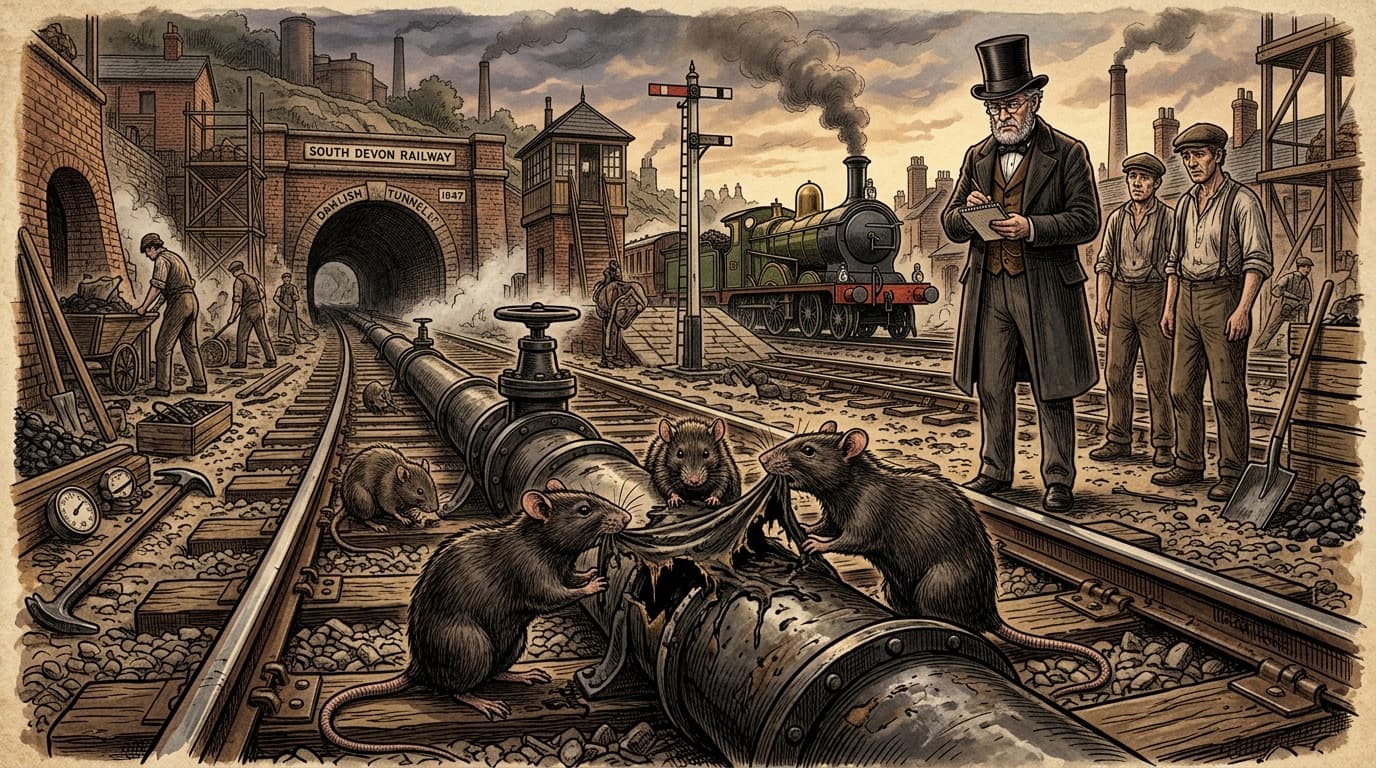
The Train That Fed the Rats: Brunel's Vacuum-Powered Railway Fiasco
The Victorian era was an age of unbridled engineering audacity, a time when no idea seemed too monumental or bizarre to attempt. At the forefront of this industrial vanguard was Isambard Kingdom Brunel, a man whose very name conjures images of massive iron ships and sprawling bridges. Brunel was the rockstar engineer of the 19th century, a man who didn't just want to build the future; he wanted to design it with flair. But even geniuses have their off days, and one of Brunel’s most spectacular, and ultimately comical, failures was the South Devon Atmospheric Railway—a futuristic transit system brought to its knees by an army of hungry rats.
In the 1840s, Great Britain was in the grips of "Railway Mania." Tracks were being laid across the countryside at a blistering pace. However, early steam locomotives had significant drawbacks. They were incredibly heavy, obnoxiously loud, belched thick black smoke, and, crucially, they struggled to climb steep gradients. When Brunel was tasked with extending the Great Western Railway through the hilly, picturesque terrain of South Devon in 1844, he realized conventional steam trains would require massive, expensive earthworks to flatten the route.
Instead, Brunel opted for a radical alternative: the atmospheric railway. The concept was elegant in its sci-fi simplicity. Rather than equipping each train with a heavy, coal-burning engine, Brunel proposed placing powerful stationary steam engines in pumping houses spaced every few miles along the track. These pumping houses would suck air out of a 15-inch cast-iron pipe laid right between the rails. A train carriage would be equipped with a piston that slotted into this pipe. Turn on the pumps, create a vacuum ahead of the train, and the atmospheric pressure behind it would literally suck the train down the track.
It sounded like a utopian dream. Without a heavy locomotive, the trains would be lighter, meaning the tracks could be laid on steeper hills. Without coal, the journey would be whisper-quiet, smooth, and soot-free.
But there was one major engineering hurdle: the longitudinal valve. To connect the moving train to the piston inside the vacuum tube, there had to be a continuous slit along the top of the entire pipe. For the vacuum to work, this slit had to seal itself instantly after the train passed. Brunel’s solution was a continuous flap of leather, hinged on one side, and heavily coated in a mixture of tallow (rendered animal fat) and beeswax to keep it supple and airtight.
When the South Devon Atmospheric Railway opened to the public in 1847, it was an absolute marvel. It felt like magic. Unburdened by massive engines, the trains hit astonishing speeds of up to 68 miles per hour—an unimaginable velocity for people used to horse-drawn carriages. Passengers were thrilled by the clean, silent glide along the spectacular coastal route. For a brief, shining moment, it looked as though Brunel had reinvented travel.
Then, the realities of the physical world—and the local wildlife—set in.
The leather valve proved to be an absolute nightmare. The harsh coastal weather was its first enemy. During the freezing British winters, the leather turned stiff and the tallow froze solid, making the seal brittle and useless. When summer arrived, the hot sun melted the tallow, causing the grease to run off and the leather to dry out and curl.
But the final, fatal blow came from an unexpected adversary. To the local rat population, miles of leather slathered in delicious, high-calorie beef and mutton fat wasn't an engineering marvel; it was the longest, most opulent charcuterie board in existence. Drawn by the smell of the tallow, rats descended on the tracks in droves, gnawing away at the leather flaps and destroying the vital vacuum seal.
Without a tight seal, the pumping stations couldn't generate enough suction. Trains would dramatically slow down, stall in the middle of the countryside, and leave furious, well-dressed Victorian passengers with no choice but to get out and push their futuristic carriages to the nearest station.
Maintenance costs skyrocketed as crews desperately tried to replace the chewed-up leather and ward off the rodent invasion. By September 1848, less than a year after its triumphant opening, the situation was untenable. The project was bleeding money, and an embarrassed Brunel had to admit defeat. The beautiful pumping houses were shut down, the iron vacuum pipes were ripped up and sold for scrap, and the reliable, smoky steam locomotives were brought in to take over the route.
Today, the South Devon Atmospheric Railway is remembered as a glorious, expensive fiasco. Yet, there is something deeply admirable about it. It stands as a testament to the 19th-century spirit of innovation, an era where brilliant minds dared to build the impossible, even if they occasionally forgot to factor in the appetite of the local rodents.