The Bones That Broke the Human Tree: How a Misunderstood Skull in the Neander Valley Changed History
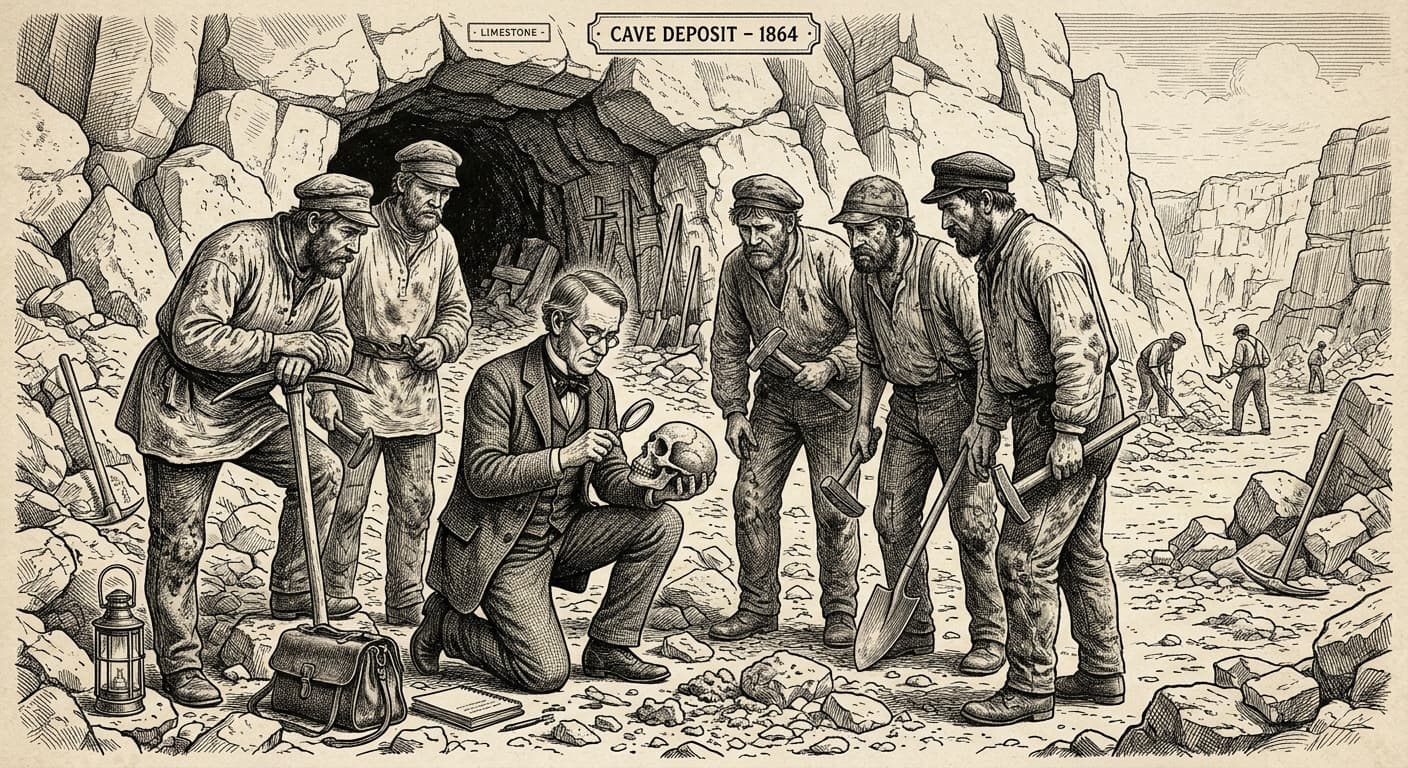
In the scorching August of 1856, deep within the idyllic Neander Valley of Prussia, a team of quarrymen were busy blowing up the landscape. As they cleared the rubble from a small limestone cave known as the Feldhofer Grotte, their pickaxes struck something entirely unexpected: bones. Assuming they had unearthed the remains of an unlucky cave bear, the workers tossed the muddy fragments aside and went back to their grueling labor. Little did they know, they had just discarded the most important skeleton in human history.<br><br>Fortunately, the bones caught the attention of the quarry's owner, who suspected they might be of interest to Johann Carl Fuhlrott, a local high school teacher and amateur naturalist. When Fuhlrott arrived and brushed the dirt from the strange, heavy skull cap, his heart must have skipped a beat. This was no bear. The skull had a massive, protruding brow ridge, a violently sloping forehead, and bone walls of immense thickness. The limb bones accompanying it were heavily bowed and thicker than any normal human's.<br><br>Fuhlrott realized with chilling clarity that he was holding the remains of a human, but not a human like anyone walking the earth today. He hypothesized that the bones belonged to a very ancient race of humans, ones that predated modern history. To legitimize his findings, he presented the bones to Hermann Schaaffhausen, an anatomy professor in Bonn. Schaaffhausen agreed, arguing that these were the remains of an ancient, primitive human tribe.<br><br>But there was a massive problem. The year was 1856. Charles Darwin's 'On the Origin of Species' would not be published for another three years. The scientific and religious consensus of the 19th century held that human beings were immutable, created precisely as they were, unchanging since the dawn of time. To suggest that an entirely different, primitive species of human once existed was not just radical; to the Victorian scientific elite, it was borderline scientific heresy.<br><br>The backlash from the academic heavyweights was swift, merciless, and, in retrospect, highly comical. The undisputed titan of German science at the time was Rudolf Virchow, widely known as the 'Pope of Medicine.' Virchow examined the bones and vehemently declared that they did not belong to an ancient ancestor. Instead, he concluded, this was merely a modern human who had suffered a remarkably bad run of luck.<br><br>According to Virchow and his supporters, the heavy, bowed leg bones were clearly the result of severe childhood rickets. The massive brow ridge? That was simply abnormal bone growth caused by the man chronically furrowing his brow in agonizing pain from his rickets. As for how he ended up in the cave, another prominent scientist confidently proposed that the skeleton belonged to a deserted Russian Cossack soldier from the Napoleonic Wars of 1814. The Cossack, plagued by rickets and with legs bowed from a lifetime in the saddle, supposedly crawled into the Feldhofer Grotte to die.<br><br>For years, the 'diseased Cossack' theory prevailed. The academic establishment effectively laughed Fuhlrott and Schaaffhausen out of the room. Poor Fuhlrott returned to his classroom, his groundbreaking discovery dismissed as a mere pathological curiosity. He was never given the academic respect he deserved during his lifetime.<br><br>However, the tide of history could not be held back by the stubbornness of one generation's scientists. Following the publication of Darwin's theory of evolution in 1859, the scientific framework began to shift. Then, in 1864, the Irish geologist William King examined a cast of the skull. Realizing its distinct and ancient characteristics, King formally declared it an entirely separate species. He named it Homo neanderthalensis, after the valley where it was found.<br><br>The final vindication for the humble schoolteacher came in 1886, nine years after Fuhlrott's death. In a cave in Spy, Belgium, researchers unearthed two more skeletons with the exact same heavy brow ridges and robust bones. Only this time, they were buried alongside extinct Ice Age animals and ancient stone tools. Virchow's 'diseased Cossack' theory evaporated. No one could seriously argue that two more rickety cavalrymen had crawled into a Belgian cave to die among mammoth bones.<br><br>Today, Neanderthal 1 remains one of the most studied fossils in the world. What started as a discarded pile of 'bear bones' in a German quarry fundamentally shattered the 19th-century illusion of human exceptionalism. It proved that the human family tree was not a single, straight trunk, but a wild, tangled bush of species. And it all began with a curious schoolteacher who dared to look at an odd skull and see the face of our forgotten cousins staring back.