The Bloody Mark: How a Gruesome 1892 Murder Birthed Modern Forensics
For most of the 19th century, catching a criminal was largely a matter of eyewitness testimony, circumstantial evidence, and sheer luck. If a thief left town and changed his name, he effectively became a new person. By the 1880s, French police officer Alphonse Bertillon attempted to bring science into the fold by inventing "anthropometry" (often called Bertillonage). This system involved taking meticulous measurements of a suspect's body parts—head length, middle finger length, foot size—and pairing them with a frontal and profile photograph. It was highly flawed. The measurements required perfectly calibrated instruments, were subject to human error, and completely useless if the criminal left no physical body behind at the scene. Law enforcement desperately needed a foolproof way to place a specific person at the scene of a crime.
The answer did not come from the sophisticated laboratories of London or Paris, but from a dusty, windswept coastal town in Argentina.
In June 1892, a horrific crime shocked the small community of Necochea. A 27-year-old woman named Francisca Rojas was found in her home suffering from a superficial knife wound to her neck. Tragically, her two young children, a four-year-old boy and a girl, were found dead in their beds, their skulls crushed. When police questioned the grieving mother, Rojas pointed the finger directly at her neighbor, a man named Pedro Velázquez. According to Rojas, Velázquez had repeatedly proposed marriage to her. When she rejected him, he took his revenge on her children and attempted to kill her as well.
The local police did what 19th-century police often did: they arrested Velázquez and employed brutal methods to extract a confession. They tied him up and tortured him for a week. Yet, despite the agonizing treatment, Velázquez steadfastly maintained his innocence. What’s more, several witnesses corroborated his alibi. The investigation hit a brick wall, and the local authorities sent an urgent message to the provincial police headquarters in La Plata for assistance.
Enter Inspector Eduardo Álvarez. Unbeknownst to the murderers of the world, Álvarez had a secret weapon back at headquarters. A Croatian-born police official named Juan Vucetich had been quietly developing a radical new system of identification. Inspired by the writings of British polymath Francis Galton, Vucetich believed that the friction ridges on the tips of human fingers were entirely unique to each individual. He had just established the world's first fingerprint bureau in La Plata, naming his classification system "dactyloscopy." Vucetich had meticulously trained Álvarez in the careful art of finding and lifting these intricate patterns.
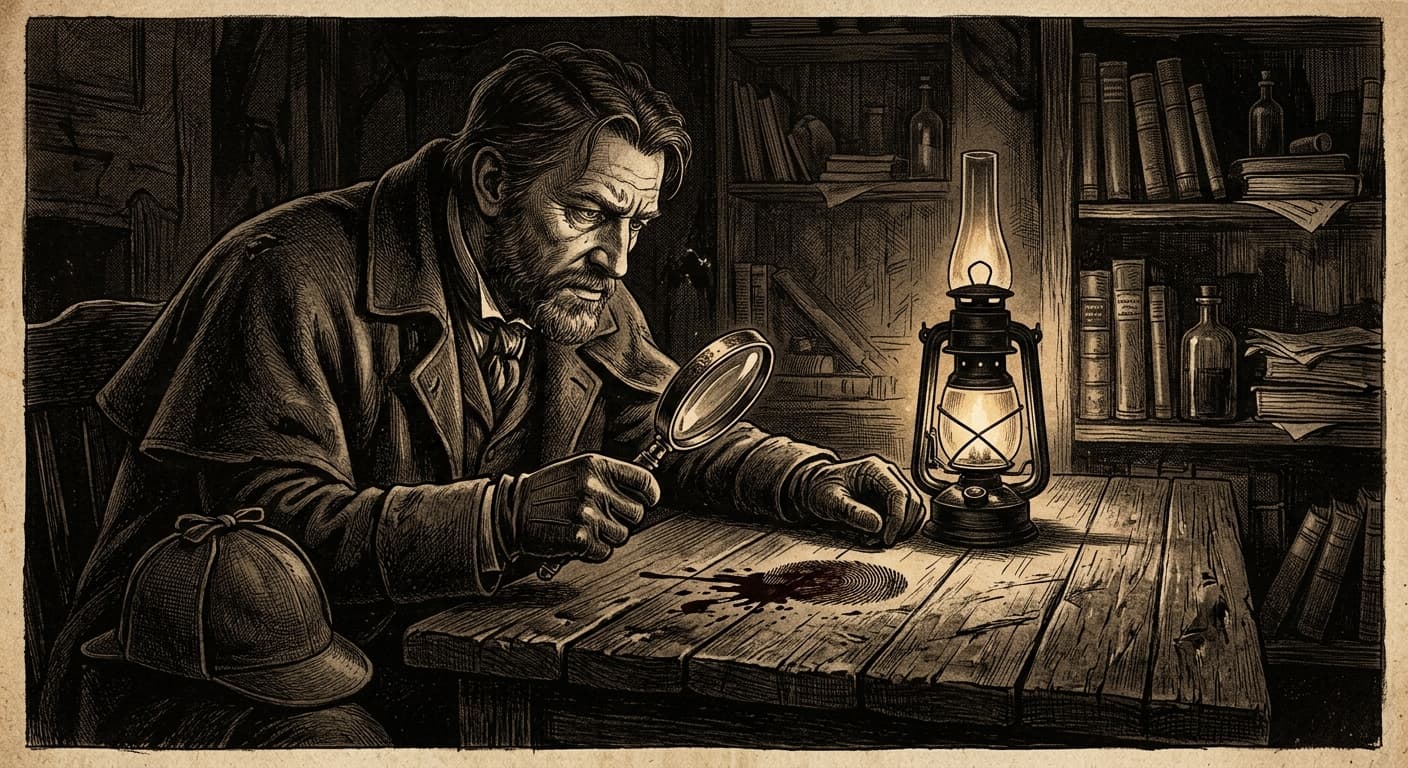
When Álvarez arrived in Necochea, he didn't just interrogate the suspect; he methodically examined the crime scene. On the wooden doorframe of the bedroom where the children were found, Álvarez spotted something that the local police had completely overlooked: a single, bloody thumbprint.
Knowing the immense potential significance of this mark, Álvarez took a saw and physically cut the piece of wood out of the doorframe to preserve the evidence. He then returned to Francisca Rojas. Although she was still presenting herself as the grieving victim, Álvarez had a strong hunch. He forced the uncooperative mother to press her ink-stained thumb onto a piece of paper. He then took out his magnifying glass and carefully compared the freshly inked print to the bloody mark on the doorframe.
The loops and whorls were an exact, undeniable match. It was a perfect physical link.
Confronted with the irrefutable evidence of her own body, Rojas’s facade crumbled. She broke down and confessed to the unthinkable. She had murdered her own children because her much younger boyfriend wanted to marry her, but explicitly refused to take on the burden of raising another man's offspring. She had wounded herself and blamed the neighbor to cover her tracks. Francisca Rojas became the very first person in history to be convicted of a crime based on fingerprint evidence.
The impact of the Rojas case was monumental and effectively changed criminal justice forever. While Scotland Yard and other elite European agencies were still clinging to the clunky Bertillon system, Argentina fully adopted dactyloscopy. By 1903, the Argentine police had abandoned bodily measurements entirely, becoming the first country in the world to rely strictly on fingerprints. Juan Vucetich’s pioneering work revolutionized forensic science, ensuring that from 1892 onward, criminals could no longer simply wash their hands of their misdeeds. The bloody mark in Necochea proved that our bodies carry a permanent signature, one that even the most cunning murderers cannot erase.