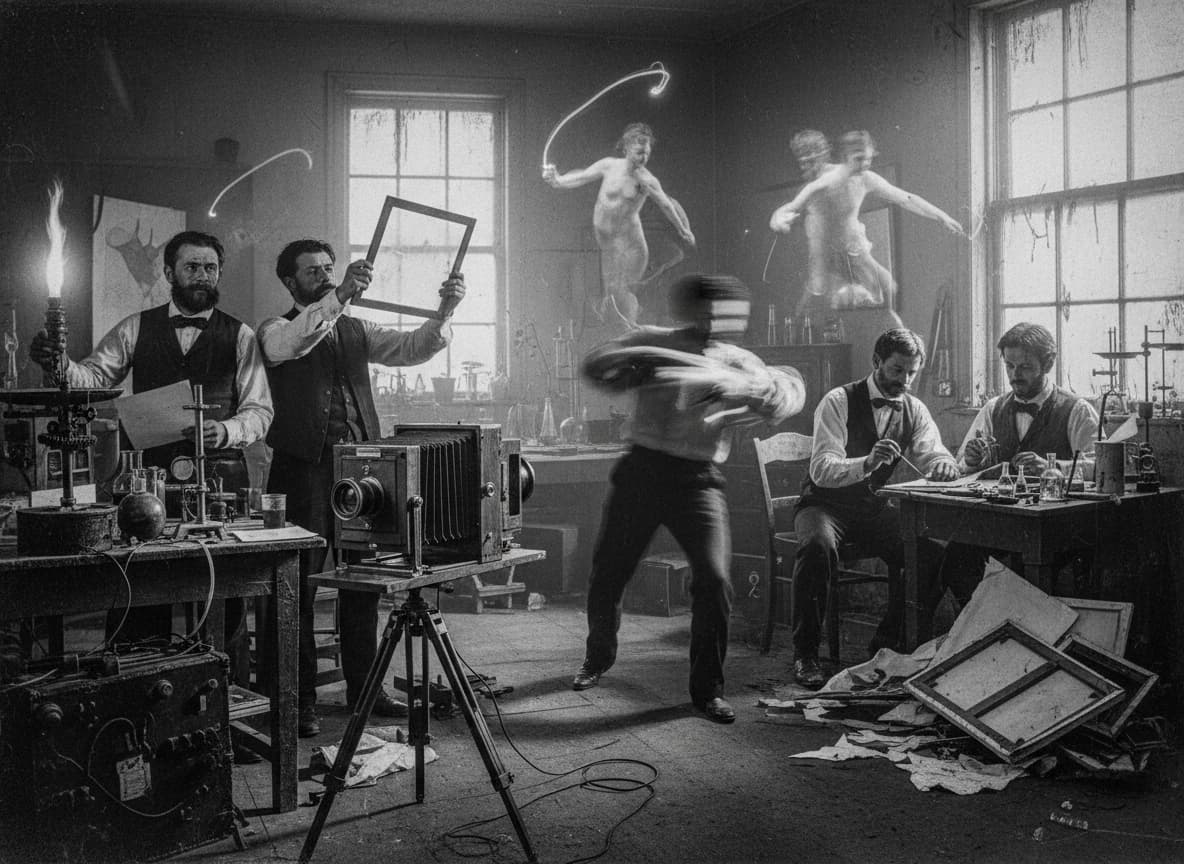
Beyond the Canvas: The 19th Century's Revolutionary Quest to Freeze Time
Imagine a world where the only way to preserve a visual memory was through painstaking painting, drawing, or the limited accuracy of written description. A world without selfies, without news photos, without family albums. This was the reality for humanity for millennia. Then, in the early 19th century, a scientific and artistic revolution began to simmer, culminating in breakthroughs that would forever alter how we perceive, remember, and document our world. It was a race against time, a battle of chemistry and light, fought by brilliant minds seeking to capture the ephemeral.
For centuries, artists and scientists had experimented with optics, notably the camera obscura, a darkened room or box with a small hole that projected an inverted image onto a surface. It was a tool for drawing, a precursor, but it couldn't fix the image. The dream of permanently capturing these transient light-paintings haunted many. From Johann Heinrich Schulze's early experiments with silver salts darkening in light in the 1720s, the scientific groundwork was slowly being laid, but no one could stop the image from fading once exposed to continuous light.
Our story truly begins with Nicéphore Niépce, a French inventor who, by 1826 or 1827, managed to create the world's first permanent photograph, a rather indistinct view from his window, using bitumen of Judea spread on a pewter plate. He called it "heliography" (sun drawing). While an astonishing achievement, the process was incredibly slow, requiring an exposure of several days, and the results were crude. Niépce's genius was in identifying light-sensitive materials, but his method needed refinement.
Enter Louis-Jacques-Mandé Daguerre, a celebrated French artist and showman known for his popular "Diorama" theatrical spectacles. He partnered with Niépce in 1829, and after Niépce's death in 1833, Daguerre continued the work, eventually making a monumental leap. By 1837, Daguerre had discovered that exposing a silver-plated copper sheet to iodine vapor, then exposing it to light in a camera, and finally developing the latent image with mercury vapor, produced incredibly detailed and sharp images. The daguerreotype was born.
When Daguerre publicly announced his process in August 1839, the world was stunned. The images were breathtakingly clear, almost hyper-real, capturing every minute detail with astounding precision. Parisians flocked to studios, eager to have their likenesses captured. The Daguerreotype was an instant sensation, spreading rapidly across Europe and America. However, it had limitations: each image was a unique, fragile metal plate, a direct positive, meaning no copies could be easily made. The exposure times, though dramatically reduced from Niépce's days to minutes, still required subjects to remain perfectly still.
Meanwhile, across the English Channel, independently and almost simultaneously, an English polymath named William Henry Fox Talbot was on a similar quest. Frustrated by his inability to accurately sketch landscapes with a camera lucida, he began experimenting with light-sensitive paper in the mid-1830s. By 1835, he had successfully created "photogenic drawings" – contact prints of objects on paper.
Talbot's crucial innovation, perfected by 1840 and patented as the Calotype (or Talbotype), was the negative-positive process. He created a translucent paper negative from which multiple positive prints could be made. While his early Calotypes lacked the astonishing sharpness of Daguerreotypes, their ability to produce multiple copies was a profound conceptual leap. This was the fundamental principle upon which almost all photography would operate for the next 150 years, until the advent of digital imaging. Talbot effectively laid the groundwork for modern photographic printing, mass distribution of images, and the very concept of a photographic archive.
The simultaneous announcements of Daguerre's and Talbot's processes led to a flurry of debate and rivalry, often dubbed the "war of patents." While the French government generously acquired Daguerre's patent and made it free to the world (except in England, where he had a private patent), Talbot was rigorous in enforcing his patents, which arguably hindered the adoption and development of his Calotype in Britain. Despite this, both men are rightly hailed as the fathers of photography, each contributing a vital, distinct piece to the puzzle.
The impact of photography was immediate and far-reaching. Portraiture, once the luxury of the wealthy, became accessible to the burgeoning middle class. Science gained an invaluable tool for observation and documentation. Journalism found a new eye to capture events. Art was both challenged and inspired. Photography became a personal archive, a public record, and a potent force for social change.
From the first faint images on a pewter plate to the crisp Daguerreotypes and the endlessly reproducible Calotypes, the 19th century witnessed not just the invention of a device, but the birth of a new way of seeing, remembering, and understanding our shared human experience. These pioneers, with their relentless curiosity and groundbreaking experiments, didn't just capture shadows; they illuminated the future.