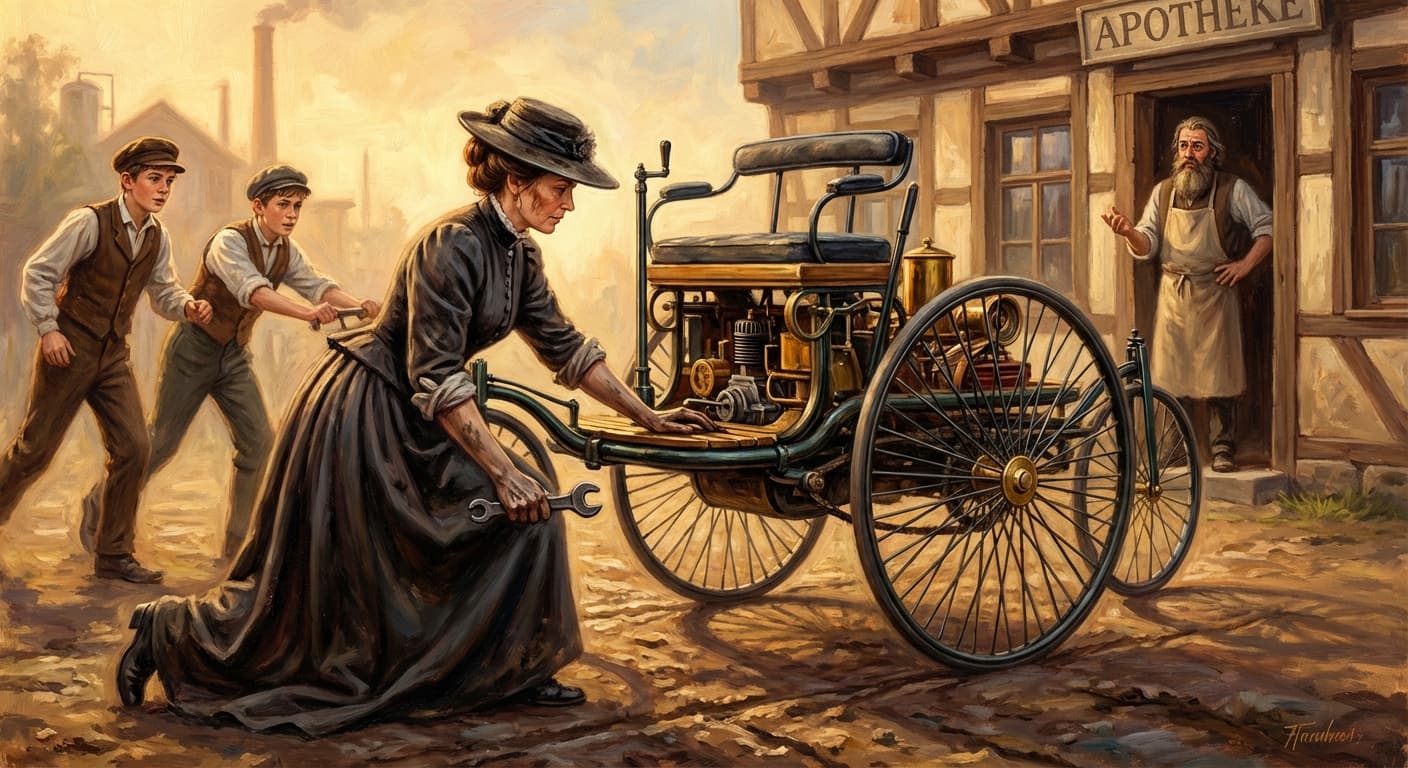
The Unauthorized Odyssey: How Bertha Benz Jump-Started the Automotive Age
In the summer of 1888, the automobile was not considered the future of transportation; it was considered a public nuisance. It was loud, smelly, terrified horses, and was largely viewed as the eccentric hobby of tinkering madmen. One of those tinkers was Karl Benz, a brilliant German engineer who had patented the Patent-Motorwagen, widely regarded as the first true automobile. But Karl was a perfectionist and prone to bouts of depression. Despite his mechanical genius, he lacked the marketing prowess to show the world what his invention could actually do. He was afraid to take the machine outside the factory walls of Mannheim for fear of public humiliation. His wife, Bertha Benz, however, had no such fears.
At dawn on August 5, 1888, while Karl was still asleep, Bertha made a decision that would change the course of history. She didn't ask for permission; she simply left a note on the kitchen table saying she was going to visit her mother in Pforzheim. She did not mention that she was taking the prototype Model III—a three-wheeled, open-air contraption with a tiller for steering—or that she was taking their two teenage sons, Eugen and Richard, along as the engine crew. Thus began the first long-distance road trip in human history, a journey of approximately 66 miles (106 km) that would test the limits of 19th-century engineering and the fortitude of a Victorian woman.
The Drive Into the Unknown
To understand the audacity of this trip, one must realize that there were no roads suitable for cars, no road maps, and certainly no gas stations. The Motorwagen had no fuel tank to speak of, only a small supply in the carburetor. The fuel required was ligroin, a petroleum spirit used as a solvent, which could only be purchased at apothecaries (pharmacies). Consequently, the city pharmacy in Wiesloch became the world's first filling station when Bertha stopped to refuel, much to the chemist's confusion.
The journey was fraught with mechanical failures that would have stopped a lesser team. But Bertha Benz proved to be the world’s first automotive mechanic. When the fuel line clogged, she didn't call for help; she used her long hatpin to clear the blockage. When the ignition wire short-circuited, she sacrificed her garter to use as an insulator. When the wooden brakes began to fail during the steep descent from the hills, she visited a local cobbler and demanded he nail strips of leather onto the brake blocks, inadvertently inventing the world's first brake pads.
Over the Hills and Far Away
The physical toll was just as demanding as the mechanical one. The car possessed a single-cylinder, 2.5-horsepower engine. It struggled immensely on inclines. Every time the road pitched upward, Bertha and her sons had to get out and push the heavy steel contraption uphill. It was an exhausting, dirty, and chaotic ordeal. Spectators in the villages they passed watched in stunned silence or shouted regarding the "witchcraft" of the horseless carriage. Yet, Bertha pressed on, determined to prove that her husband’s invention was not merely a toy, but a functional machine capable of traversing long distances.
They arrived in Pforzheim at dusk, dusty and exhausted but triumphant. Bertha sent a telegram to her frantic husband: "Arrived safe and sound in Pforzheim." She had completed the journey. Three days later, they drove the car back to Mannheim via a different route to avoid some of the steeper hills.
The Legacy of the Joyride
Bertha’s unauthorized joyride did exactly what she intended: it generated massive publicity. The sight of a woman and two boys traversing the German countryside in a self-propelled vehicle proved that the automobile was reliable and safe enough for the general public. It shifted the narrative from fear to fascination. Furthermore, Bertha’s feedback was invaluable to Karl. She complained that the car lacked power on hills, leading Karl to introduce a lower gear—the invention of the gearbox. She noted the brake issues, leading to better friction materials.
Without Bertha Benz’s grit, ingenuity, and belief in the machine, the Mercedes-Benz empire might never have risen. She funded the initial development with her dowry and saved the invention with her drive. In an era when women were expected to stay in the domestic sphere, Bertha Benz took the wheel and drove humanity straight into the modern age.