The Monolith of the North Sea: How the Bell Rock Lighthouse Defied the Ocean
Eleven miles off the eastern coast of Scotland lay a maritime assassin: the Inchcape Rock. Also known as the Bell Rock, this sprawling sandstone reef was uniquely deadly because it lurked just below the churning surface of the water for all but a few hours a day. For centuries, it tore the hulls out of passing merchant vessels and warships alike, claiming thousands of lives. The 19th century demanded a solution, but the engineering required to tame the reef bordered on the impossible.
The catalyst for change arrived in the winter of 1804 when the HMS York, a massive 64-gun warship, struck the Bell Rock and sank with all 491 men aboard. The sheer scale of the tragedy forced the hand of the Northern Lighthouse Board. Enter Robert Stevenson, a fiercely determined 34-year-old engineer and the future grandfather of the famous author Robert Louis Stevenson. Stevenson proposed an audaciously mad idea: he wanted to build a towering, 100-foot stone lighthouse directly on the submerged reef.
The authorities were highly skeptical of the young engineer's proposal. Building a massive stone tower on a rock that was submerged under sixteen feet of ferocious sea twice a day seemed like a fool's errand. They eventually approved the project but appointed the famous John Rennie as chief engineer to oversee the ambitious endeavor. Despite Rennie's official title and occasional visits, it was Stevenson who would spend the next four years facing the wrath of the North Sea, living on a swaying ship and standing knee-deep in freezing water to direct the monumental effort.
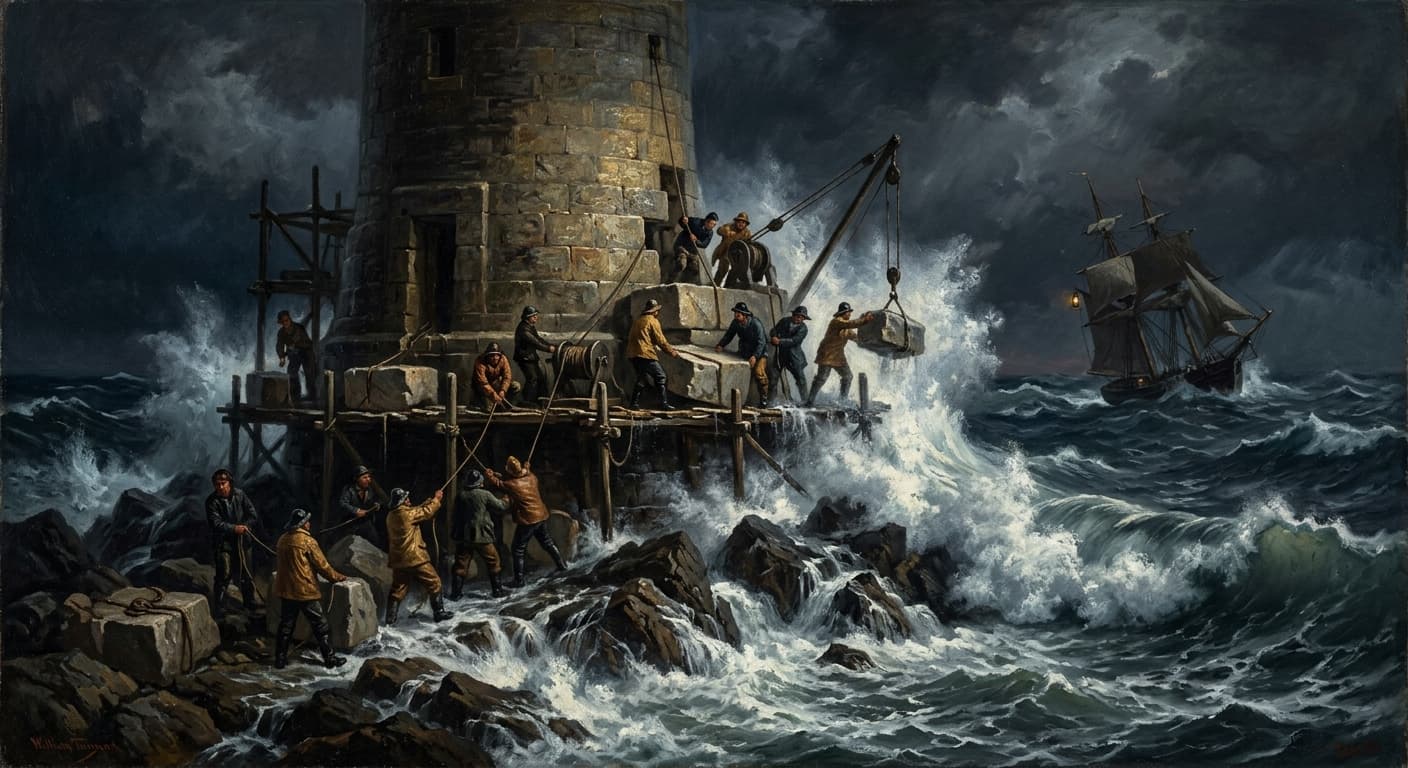
Construction officially began in the brutal summer of 1807. The logistics were an absolute nightmare. Stevenson and his crew could only work on the rock during the brief window of low tide, which sometimes allowed for as little as two hours of labor a day. The rest of the time, they were huddled in a cramped vessel moored offshore, violently pitched about by relentless storms. During those early months, the men wielded pickaxes against the unforgiving sandstone, racing against the incoming tide. If a man lingered too long, he risked being swept into the frigid abyss.
The true peril of their situation was crystallized on a chilling day in September 1807. A crew of 32 men was working on the reef when their primary supply ship, which held their provisions and served as their ride back to safety, broke its moorings and began drifting away. As the tide began to rise, the men realized there were only two small rowboats left on the rock—enough to save perhaps half of them. Stevenson later wrote of the absolute terror that gripped him as he stood on the shrinking rock, realizing he would soon have to choose who lived and who died. Just as panic threatened to overtake the crew, a massive stroke of luck occurred: a passing pilot boat, out to deliver mail, spotted them through the mist and rescued the stranded men just as the icy water reached their knees.
Unfazed by their near-death experience, Stevenson and his men stubbornly pushed forward. To survive the brutal environment and increase their working hours, Stevenson designed a temporary wooden structure known as the Beacon House. Built on massive iron legs drilled directly into the reef, this precarious structure allowed the men to live directly above the crashing waves rather than retreating to a ship. It was terrifyingly fragile. During severe gales, the sea would crash upward through the floorboards, but it dramatically improved their efficiency and morale.
The lighthouse itself was a marvel of 19th-century engineering. Borrowing and improving upon techniques previously used by John Smeaton at the Eddystone Lighthouse, Stevenson designed the granite and sandstone blocks to interlock using intricate dovetail joints. This meant the tower was not just a simple stack of stones; it was a single, unified monolith, capable of flexing and absorbing the kinetic energy of monstrous ocean waves. By 1810, the men were painstakingly laying these massive blocks, sometimes utilizing horse-drawn railways laid over the rugged reef to move stones weighing over a ton.
Finally, on February 1, 1811, the Bell Rock Lighthouse was illuminated for the very first time. The brilliant beam of light pierced the darkness of the North Sea, instantly transforming one of the world's deadliest shipping hazards into a beacon of absolute safety. The resounding success of the project catapulted Robert Stevenson to international fame and founded a legendary dynasty of lighthouse engineers who would go on to illuminate the entire treacherous Scottish coastline.
Today, more than two centuries later, the Bell Rock Lighthouse still stands defiant against the waves. It has never once been breached or brought down by the sea. As the world's oldest surviving sea-washed lighthouse, it remains a breathtaking testament to the audacity of 19th-century engineering. It stands as a towering monument to a time when men armed with little more than pickaxes, sailing ships, and sheer stubbornness successfully declared war on the ocean—and won.