The Lawman Behind the Legend: The Real Lone Ranger of the Wild West
When we conjure images of the American Wild West, Hollywood has conditioned us to see a very specific archetype: the stoic, square-jawed white cowboy riding into the sunset. We think of John Wayne, Clint Eastwood, or the fictional Lone Ranger. Yet, historians estimate that one in four cowboys was Black, and among the lawmen who tamed the lawless territories, few cast a longer shadow than Bass Reeves. A man who escaped slavery to become one of the most feared and respected U.S. Deputy Marshals in history, Reeves is the genuine article—a figure so larger-than-life that he is widely believed to be the true inspiration behind the Lone Ranger.
Born into slavery in Arkansas around 1838, Reeves’ early life was defined by the brutal constraints of the antebellum South. However, during the chaos of the Civil War, he made a daring escape. He fled into the Indian Territory (modern-day Oklahoma), finding refuge among the Cherokee, Creek, and Seminole nations. It was during this time that Reeves honed the skills that would later define his career. He learned the landscape of the territory intimately, mastered tracking, and became fluent in several Native American languages. Perhaps most importantly, he became a crack shot with a pistol and rifle, developing an ambidexterity that allowed him to shoot accurately with either hand.
In 1875, Isaac Parker, known notoriously as the ‘Hanging Judge,’ took the bench at the Federal Court for the Western District of Arkansas. Parker needed men with grit to bring order to the Indian Territory, a 75,000-square-mile expanse that had become a haven for outlaws, murderers, and thieves. Reeves was recruited as a U.S. Deputy Marshal, becoming the first Black deputy to serve west of the Mississippi River. Standing over six feet tall with broad shoulders and a commanding presence, Reeves was an imposing figure, but it was his intellect and cunning that made him legendary.
Throughout his thirty-two-year career, Reeves was credited with arresting over 3,000 felons. He killed fourteen men in self-defense, yet he was never famously wounded himself—a miraculous feat given the violence of his beat. Unlike the shoot-first stereotypes of the era, Reeves was a master of disguise and psychology. He would often dress as a tramp, a cowboy, or an outlaw on the run to get close to his targets. In one famous instance, he walked twenty-eight miles dressed as a beggar, complete with a cane and dirty shoes, to trick two fugitives into letting him stay at their cabin. By morning, he had them both in handcuffs.
Despite being illiterate, Reeves possessed a photographic memory. He would have someone read the warrants to him before he set out, memorizing the names and charges of every suspect he was hunting. He never arrested the wrong person. His devotion to the law was absolute, creating a moral code that was tested in the most heartbreaking way imaginable. When his own son, Bennie Reeves, was charged with murdering his wife, other deputies were reluctant to take the warrant. Bass Reeves demanded the job himself. He tracked down his son, arrested him, and brought him in to face justice, proving that no one was above the law in his eyes.
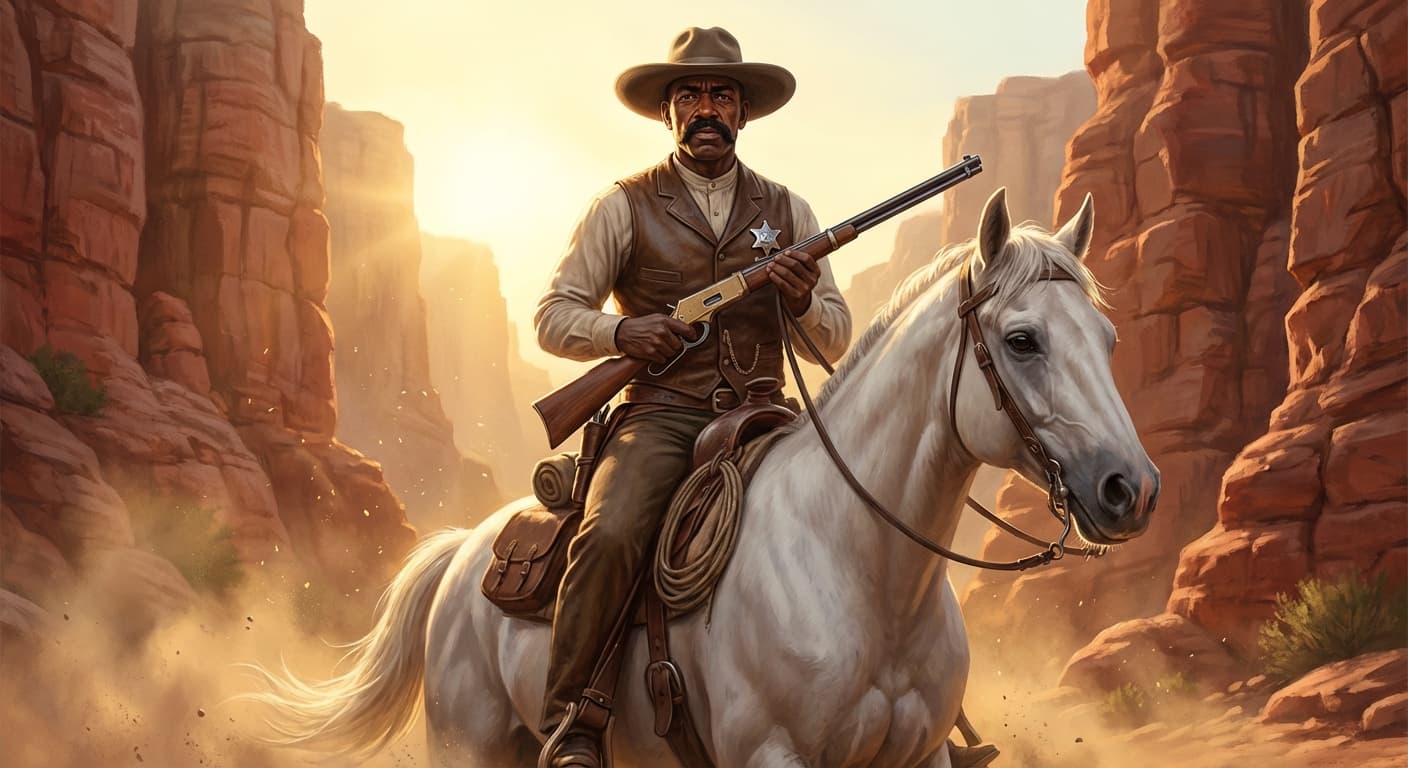
The parallels between Reeves and the fictional Lone Ranger are striking. Reeves rode a white horse (and sometimes a grey one), handed out silver dollars as his calling card, worked with a Native American tracker, and was known for his upstanding moral compass. While the creators of the radio drama never officially confirmed the inspiration, the overlap is difficult to ignore. For decades, the whitewashing of history obscured Reeves' contributions, burying the story of a man who was arguably the greatest lawman of the 19th century. Today, history is finally correcting the record, placing Bass Reeves back in the saddle where he belongs—not as a sidekick to history, but as the hero of the story.