The Audacity of Robert Smalls: Stealing Freedom from the Heart of the Confederacy
In the annals of the American Civil War, history books often focus on the grand maneuvering of generals like Grant and Lee or the political chess matches in Washington and Richmond. Yet, one of the most daring feats of the entire 19th century was not orchestrated by a West Point graduate, but by a 23-year-old enslaved man named Robert Smalls. His story is a heist movie waiting to happen—a tale of high stakes, disguise, and an unquenchable thirst for liberty that saw him steal a Confederate warship and deliver it, along with his family, into the hands of the Union Navy.
The Pilot of the Planter
Born into slavery in Beaufort, South Carolina, in 1839, Robert Smalls was leased out by his owner to work in Charleston. Over time, he became intimately familiar with the waterways of Charleston Harbor. By the outbreak of the Civil War, Smalls was working aboard the CSS Planter, a swift, shallow-draft steamer converted into an armed dispatch boat and transport for the Confederate Army.
Though he was listed merely as a wheelman (since enslaved people could not officially hold the rank of pilot), Smalls effectively piloted the ship. He knew the currents, the sandbars, and, most importantly, the complex network of signals and checkpoints required to navigate past the ring of Confederate forts guarding the harbor. He also knew something else: the white officers aboard the Planter had a habit of disobeying regulations. Despite orders to sleep aboard the vessel, the captain and his mates often spent the night ashore with their families, leaving the enslaved crew to watch the ship.
The Night of the Heist
On the evening of May 12, 1862, the opportunity Smalls had been planning for arrived. The Planter was docked at a wharf in Charleston, loaded with four heavy guns intended for a Confederate fort. Once the white officers disembarked for the night, Smalls put his plan into motion. He confided in the other enslaved crew members; if they were caught, they agreed they would blow up the ship rather than be taken alive. Failure meant execution.
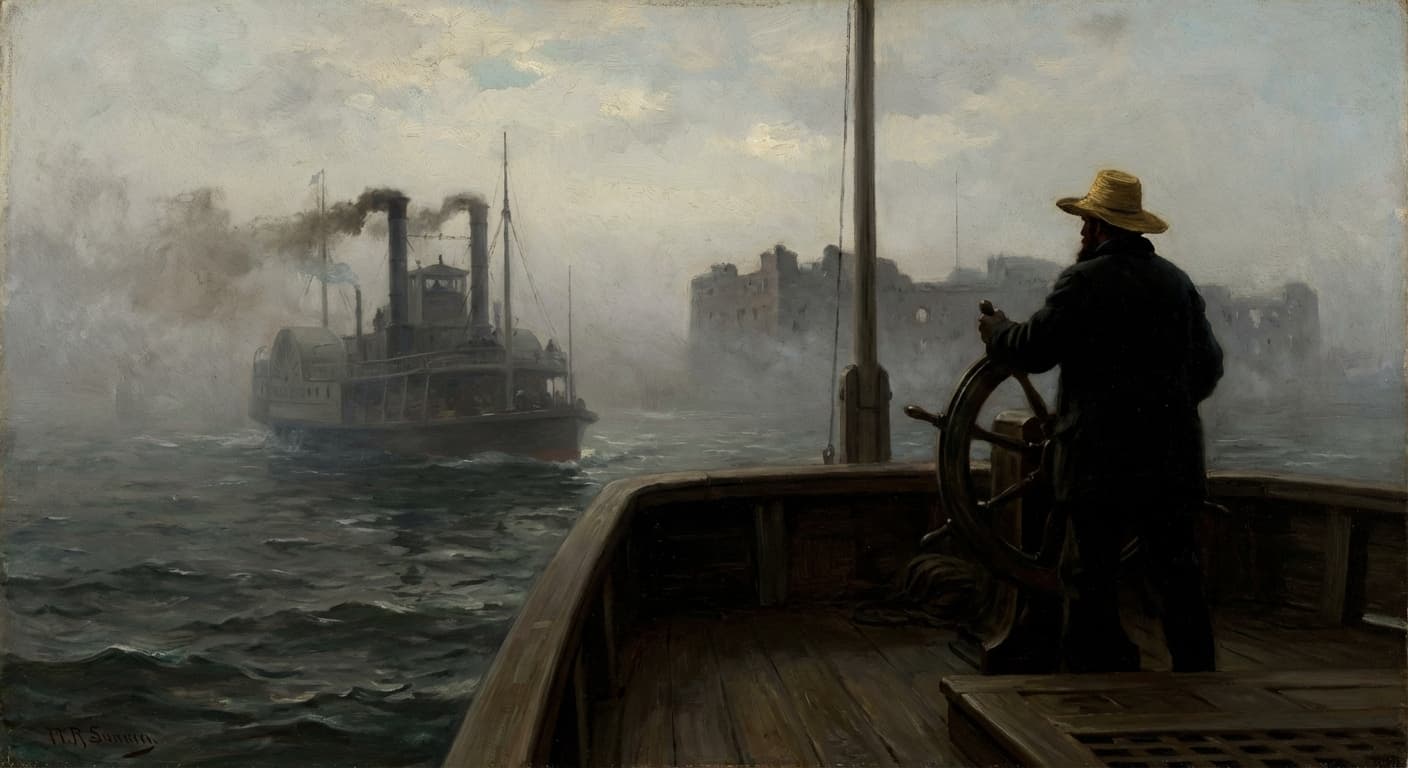
In the pre-dawn darkness of May 13, Smalls donned the captain’s wide-brimmed straw hat and long overcoat to mimic the commander's silhouette. Under his direction, the crew lit the boilers. They hoisted the Confederate flag and the South Carolina palmetto flag to maintain the ruse. Slowly, audaciously, the Planter pulled away from the dock.
The first stop was a nearby wharf to pick up Smalls’ wife, children, and the families of the other crew members, who had been hiding in wait. Now carrying 16 enslaved people, the Planter turned toward the open sea. The journey was a gauntlet of terror. They had to pass five Confederate harbor forts, the most formidable being Fort Sumter—the very flashpoint of the war.
Running the Gauntlet
As the Planter approached Fort Sumter, the crew was paralyzed with fear. One mistake, one hesitation, and the heavy cannons of the fort would turn the wooden steamer into splinters. Smalls, however, remained calm. Mimicking the captain’s posture, he stood at the helm, his face obscured by the straw hat and the shadows of dawn. He pulled the whistle cord, giving the correct coded signal required to pass: two long blasts and a jerk.
The sentry at Sumter, seeing the familiar silhouette and hearing the correct signal, shouted, "Pass the Planter!" Smalls shouted back a casual "Blow the damned Yankees to hell, or bring one of them in!"—a common Confederate jest—and sailed past the guns. once out of range, the ruse was dropped. Smalls ordered the Confederate colors struck and raised a white bedsheet his wife had brought for this exact moment.
A Gift to the Union
Just outside the harbor lay the Union blockade fleet. The USS Onward spotted the approaching steamer. Seeing a ship emerging from Charleston, the Union sailors readied their guns, preparing to fire. At the last second, the morning fog lifted just enough to reveal the white flag fluttering in the wind.
Smalls steered the ship alongside the Onward. When the Union captain hailed him, Smalls removed his hat and shouted, "Good morning, sir! I have brought you some of the old United States guns, sir!" He surrendered the Planter, its cargo of artillery, the codebook of Confederate signals, and the map of mines in the harbor. But the most valuable cargo was the 16 souls who had gone to sleep as property and woke up free.
The Legacy of a Hero
The escape was a sensation in the North. Congress passed a bill awarding Smalls and his crew prize money for the ship. But Smalls wasn’t done. He met with President Abraham Lincoln and Secretary of War Edwin Stanton, reportedly helping to convince Lincoln to allow African American men to enlist in the Union Army. Smalls himself served the Union with distinction, eventually becoming the captain of the very ship he had stolen—the first black man to command a United States naval vessel.
After the war, Robert Smalls returned to South Carolina, bought his former master's house, and served five terms in the U.S. House of Representatives. In a century defined by the struggle for human rights, Robert Smalls didn't just wait for freedom to be granted; he seized the wheel and steered straight for it.