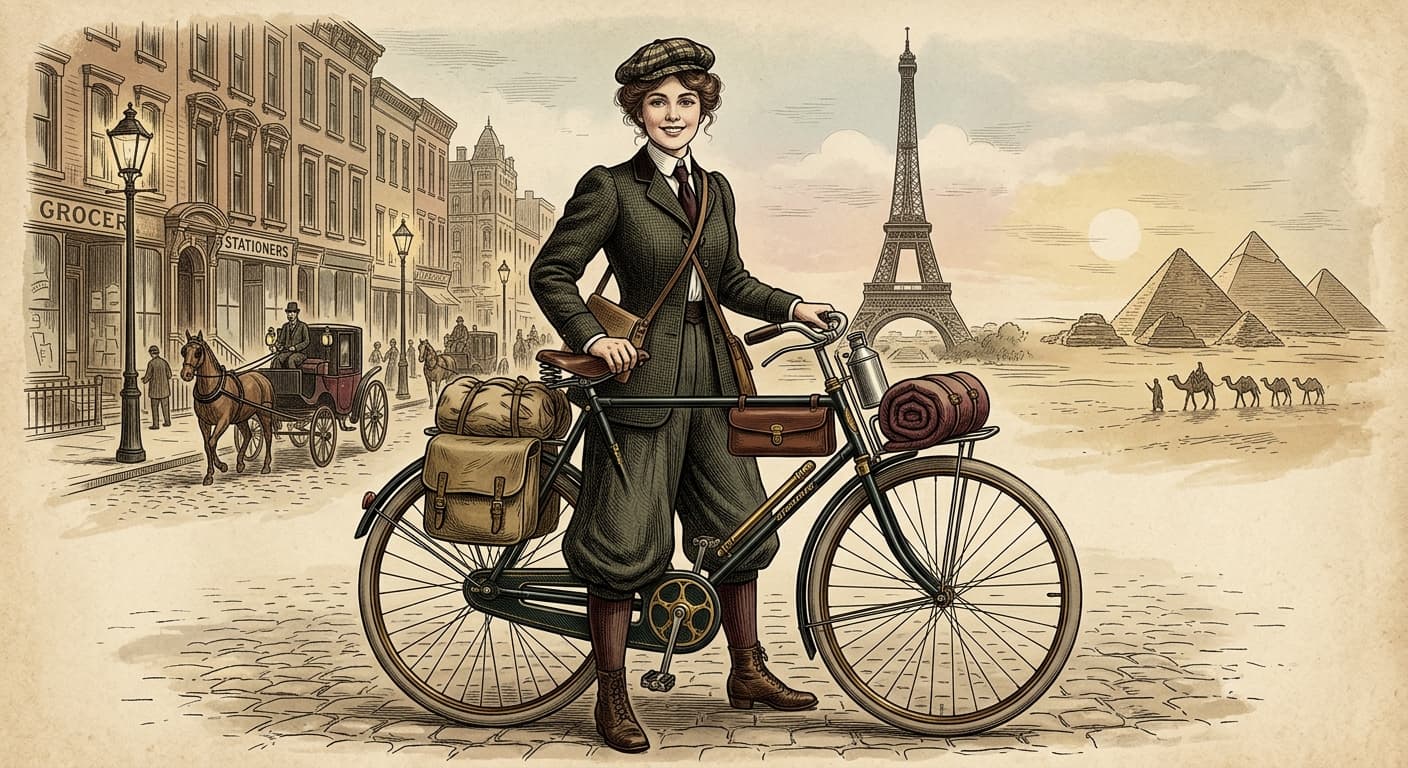
The Pedaling Huckster: How Annie Londonderry Bicycled Around the World and Reinvented Herself
The bicycle craze of the 1890s transformed the Victorian world. The bicycle was the smartphone of its era—a revolutionary piece of technology that gave people unprecedented freedom and mobility. For women in particular, the "wheel" was a magnificent engine of liberation, offering an escape from suffocating domestic spheres and highly restrictive fashion. But in 1894, a tantalizing question gripped the sporting world: just how far could a woman go on a bicycle? Enter a 23-year-old Jewish immigrant from Boston named Annie Kopchovsky, who decided that the answer was, quite simply, "everywhere."
The inciting incident was a supposedly massive wager. According to legend (and heavily propagated by Annie herself), two wealthy Boston clubmen had placed a $10,000 bet against a woman's ability to cycle around the world in fifteen months. To make the challenge even more Herculean, the intrepid cyclist had to start her journey completely penniless and earn $5,000 along the way. Annie, a fiercely independent mother of three with practically zero cycling experience, stepped up to the starting line to prove them wrong.
Before she even pedaled her first mile, Annie proved her genius for self-promotion. Needing funds to start her journey, she struck a revolutionary deal with the Londonderry Lithia Spring Water Company of New Hampshire. For a cool $100, she agreed to attach their advertising placard to her bicycle and temporarily change her surname. When she departed from the Massachusetts State House on June 25, 1894, she was no longer Annie Kopchovsky; she was Annie Londonderry, the world's first commercially sponsored female athlete.
Her initial setup was laughably unsuited for a grueling global expedition. She rode a 42-pound Columbia women's bicycle, which was an absolute beast to pedal, and wore a restrictive, ankle-length Victorian skirt. By the time she reached Chicago, she was exhausted, significantly behind schedule, and quickly realizing that traditional expectations of female propriety were going to cost her the wager. In a move that shocked the polite society of the 1890s, Annie swapped her heavy bike for a 21-pound men's Sterling bicycle. Even more scandalous, she ditched her heavy skirts in favor of bloomers, and eventually adopted a full men's riding suit. With a lighter frame and newfound freedom of movement, the globe-trotting journey began in earnest.
Annie's route took her from New York to Paris, through Egypt, Jerusalem, Sri Lanka, Singapore, and China. However, to call her journey a pure "cycling" expedition would be a generous stretching of the truth. Annie was a pragmatist. When roads were unrideable or time was uncomfortably tight, she happily boarded trains and steamships with her bicycle in tow. But what she lacked in purist cycling ethics, she more than made up for in sheer entrepreneurial hustle. She was, at her core, a masterful huckster ahead of her time.
To earn the required $5,000, Annie turned herself into a rolling billboard. She sold advertising space on her bicycle frame, her clothes, and even her own body. Merchants across the globe paid her to wear promotional ribbons and carry placards for everything from perfumes to bicycle tires. Furthermore, she became a highly paid lecturer in the cities she visited. Annie possessed an unparalleled gift for spinning tall tales, enthralling audiences with entirely fabricated stories of her adventures. Depending on the crowd, she claimed to have been hunted by Bengal tigers in India, ambushed by bandits in the American West, and thrown into a Japanese prison with a bullet hole through her shoulder. The press ate it up, and the public paid handsomely to hear her speak.
On September 12, 1895, Annie Londonderry rolled back into Chicago, exactly fifteen months after she had first set out, successfully winning the $10,000 wager. She had circumnavigated the globe, broken virtually every societal rule set for a 19th-century woman, and returned home significantly wealthier than when she left. The New York World declared her adventure "the most extraordinary journey ever undertaken by a woman."
Despite her monumental achievement, Annie eventually faded into obscurity, overshadowed by other historic adventurers and the impending dawn of the automobile age. Yet, her legacy remains a fascinating testament to Victorian audacity. Annie Londonderry wasn't just a pioneer of the bicycle; she was a trailblazer for women's athletics, modern sports marketing, and the enduring American tradition of faking it until you make it. She grabbed the world by the handlebars and rode it entirely on her own terms.