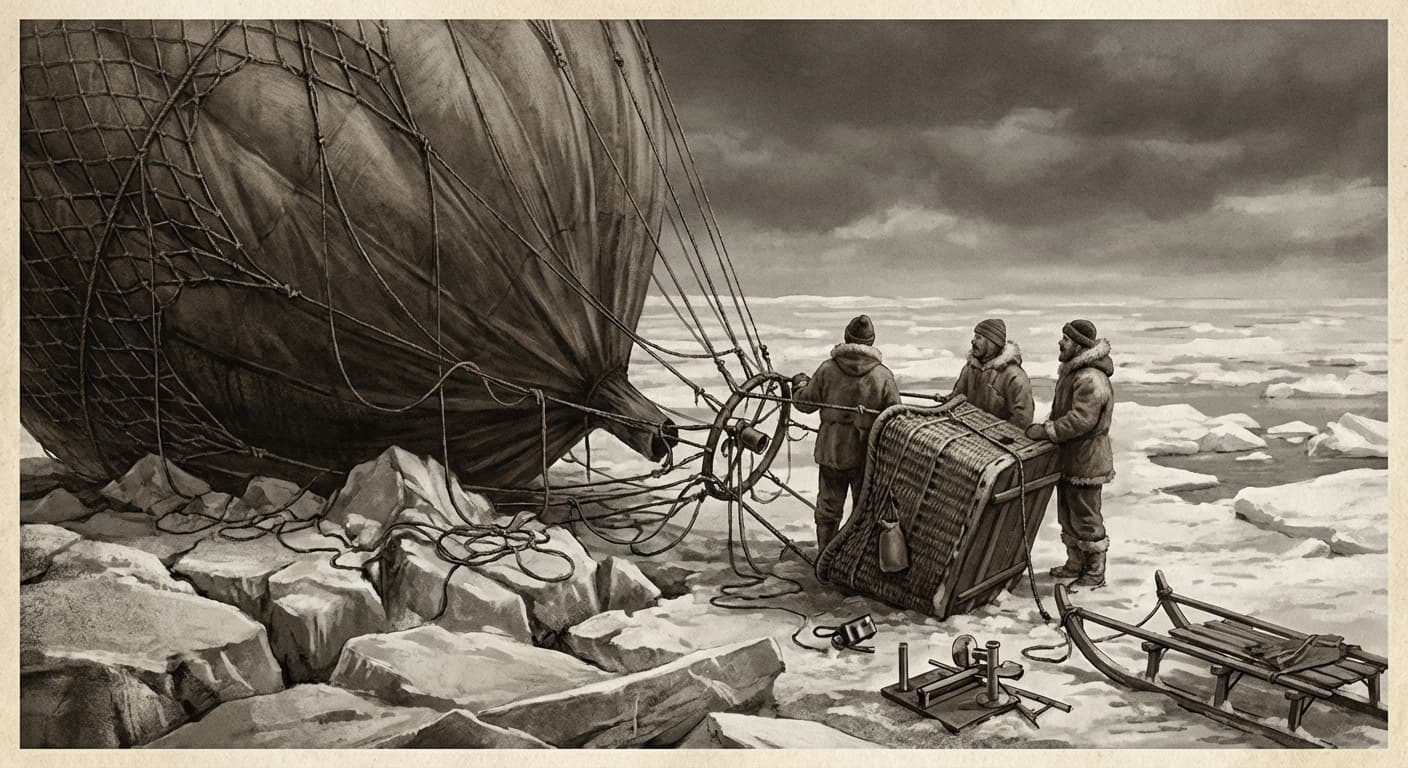
The Icarus of the Ice: The Doomed Flight of the Eagle
In the late 19th century, the map of the world was rapidly filling in. The blank spaces that had taunted cartographers for centuries were vanishing, conquered by steam, steel, and pith-helmeted determination. Yet, one great prize remained tantalizingly out of reach: the North Pole. While most explorers besieged the Arctic on ships designed to crush ice or sledges pulled by dogs, a Swedish engineer named Salomon August Andrée had a different idea. He would not fight the ice; he would simply float above it. The resulting expedition of 1897 is one of the Victorian era's most tragic tales of technological hubris, a story where the romance of ballooning collided violently with the unforgiving reality of the Arctic.
Andrée was the embodiment of the 19th-century scientific optimist. He believed that technology could master nature, and his vessel, the Örnen (The Eagle), was the cutting edge of aeronautics. It was a massive hydrogen balloon, constructed from layers of varnished silk, standing nearly 100 feet tall. But a balloon is at the mercy of the wind, and to reach the Pole, Andrée needed to steer. His solution was a complex, unproven system of heavy drag ropes that would hang from the basket, slowing the balloon’s speed relative to the wind and allowing sails to divert its course. It was a theory that worked perfectly on paper and in mild breezes, but the Arctic was neither theoretical nor mild.
On July 11, 1897, Andrée and his two younger companions, Nils Strindberg and Knut Frænkel, lifted off from Danes Island in the Svalbard archipelago. The launch was ominous. As the Eagle rose, winds battered the balloon, and in a panic to gain altitude, the crew jettisoned valuable sand ballast. Worse, the essential steering drag ropes unscrewed and fell into the sea. Within minutes of departure, the Eagle was no longer a steerable airship; it was a runaway bubble drifting helplessly northward. Yet, they did not turn back. They drifted over the horizon and out of the known world.
For thirty-three years, the fate of the Andrée expedition was one of the Arctic's greatest mysteries. Rumors swirled, and carrier pigeons released by the crew early in the voyage offered only cryptic, optimistic messages. The world assumed they had drowned in the Arctic Ocean. It wasn't until 1930 that a Norwegian scientific vessel, the Bratvaag, made a chance landing on the desolate, glacier-covered White Island (Kvitøya). There, protruding from the snow, they found a boat, scientific instruments, and the frozen remains of three men.
The discovery was a sensation, but what made it truly haunting was the recovery of the expedition's diaries and, miraculously, rolls of undeveloped film. When developed three decades later, the photographs revealed a harrowing survival epic. The Eagle had not flown to the Pole. It had leaked hydrogen and crashed onto the pack ice after just three days. The three