Beyond Byron's Daughter: Ada Lovelace, the World's First Programmer
In a world increasingly defined by algorithms, artificial intelligence, and digital innovation, it’s easy to forget that the very foundations of computer programming were laid not in a Silicon Valley garage, but in the drawing rooms and libraries of 19th-century England. And at the heart of this intellectual revolution was a woman whose brilliance burned so brightly, she was dubbed the “Enchantress of Number” by her contemporary, Charles Babbage. Her name was Augusta Ada King, Countess of Lovelace, more famously known as Ada Lovelace, and she is widely recognized as the world's first computer programmer.
Born in 1815, Ada's lineage was as dramatic as it was distinguished. She was the only legitimate child of the tumultuous marriage between the romantic poet Lord Byron and the mathematically inclined Annabella Milbanke. Fearing her daughter might inherit Byron's "poetic madness," Lady Byron deliberately steered Ada towards a rigorous education in science, logic, and mathematics. This unconventional upbringing for a Victorian lady proved to be a stroke of genius, endowing Ada with a unique blend of analytical rigor and imaginative insight – a combination crucial for her later groundbreaking work.
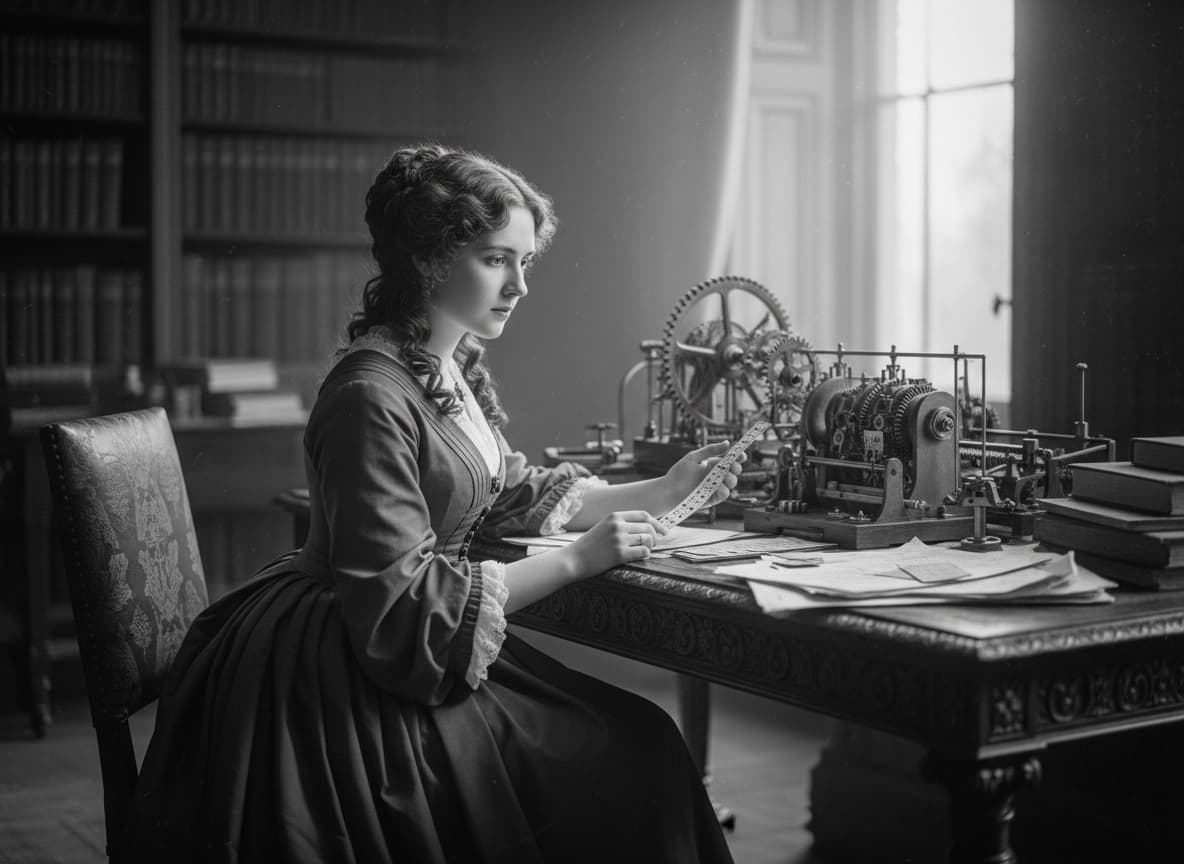
Ada's intellectual destiny truly began to unfold in 1833, at the tender age of 17, when she met the eccentric and brilliant mathematician Charles Babbage. Babbage was already famous for his Difference Engine, an automatic mechanical calculator. But it was his grander, more ambitious concept, the Analytical Engine, that truly captivated Lovelace. This wasn't just a calculator; it was a general-purpose mechanical computer, programmable with punched cards, capable of performing any calculation. Though never fully built in Babbage's lifetime, it contained all the essential logical elements of a modern computer, from a 'store' (memory) to a 'mill' (CPU).
Lovelace, with her sharp intellect, immediately grasped the revolutionary potential of Babbage's Analytical Engine. Her opportunity to contribute came in 1843 when she was commissioned to translate an article by Italian mathematician Luigi Menabrea about the Analytical Engine. However, her contribution went far beyond a mere translation. At Babbage's suggestion, she appended extensive "Notes" to the article, notes that ultimately stretched to three times the length of the original text.
It is within these legendary 'Notes' (which included 'Note G' containing the famous algorithm) that Ada Lovelace cemented her place in history. She didn't just explain how the engine worked; she envisioned what it could do. Her most significant contribution was the detailed method for calculating a sequence of Bernoulli numbers using the Analytical Engine – an algorithm specifically designed for the machine. This is widely considered the world's first computer program. More profoundly, she moved beyond simply crunching numbers, conceptualizing that the machine could process any symbols, not just numerical data. She famously wrote that the engine "might act upon other things besides number… the engine might compose elaborate and scientific pieces of music of any degree of complexity or extent." This was a stunning premonition of artificial intelligence, computer graphics, and digital music – a vision far ahead of her time.
Sadly, Lovelace's profound insights were largely unappreciated during her lifetime. The Analytical Engine remained a theoretical marvel, and her notes, while recognized by some, did not ignite an immediate revolution. She died tragically young in 1852, at the age of 36, from uterine cancer. It wasn't until the mid-20th century, with the dawn of electronic computing, that her work was rediscovered and her genius truly acknowledged. Her recognition grew, culminating in the naming of the programming language 'Ada' in her honor by the U.S. Department of Defense in 1979.
Ada Lovelace stands as a towering figure in the history of science and technology. Her legacy transcends the technical specifics of her notes; it's a testament to the power of imagination and foresight in scientific endeavor. She bridged the gap between raw mechanical computation and the abstract realm of programming, demonstrating that the future of computing lay not just in hardware, but in the sophisticated instructions that could bring machines to life. Her 'poetical science' – a term she coined herself – continues to inspire generations, proving that the most powerful innovations often emerge from the seamless blend of logic and boundless creativity.